
Looking for a spectacular mountain hike away from the crowds? The Rim Trail in Cathedral Provincial Park is well worth adding to your list.
Located in the alpine of British Columbia’s Cathedral Provincial Park, the entire 17km loop stays above 2000 metres in elevation. There are shorter options too, with a 11km circuit being a popular alternative.
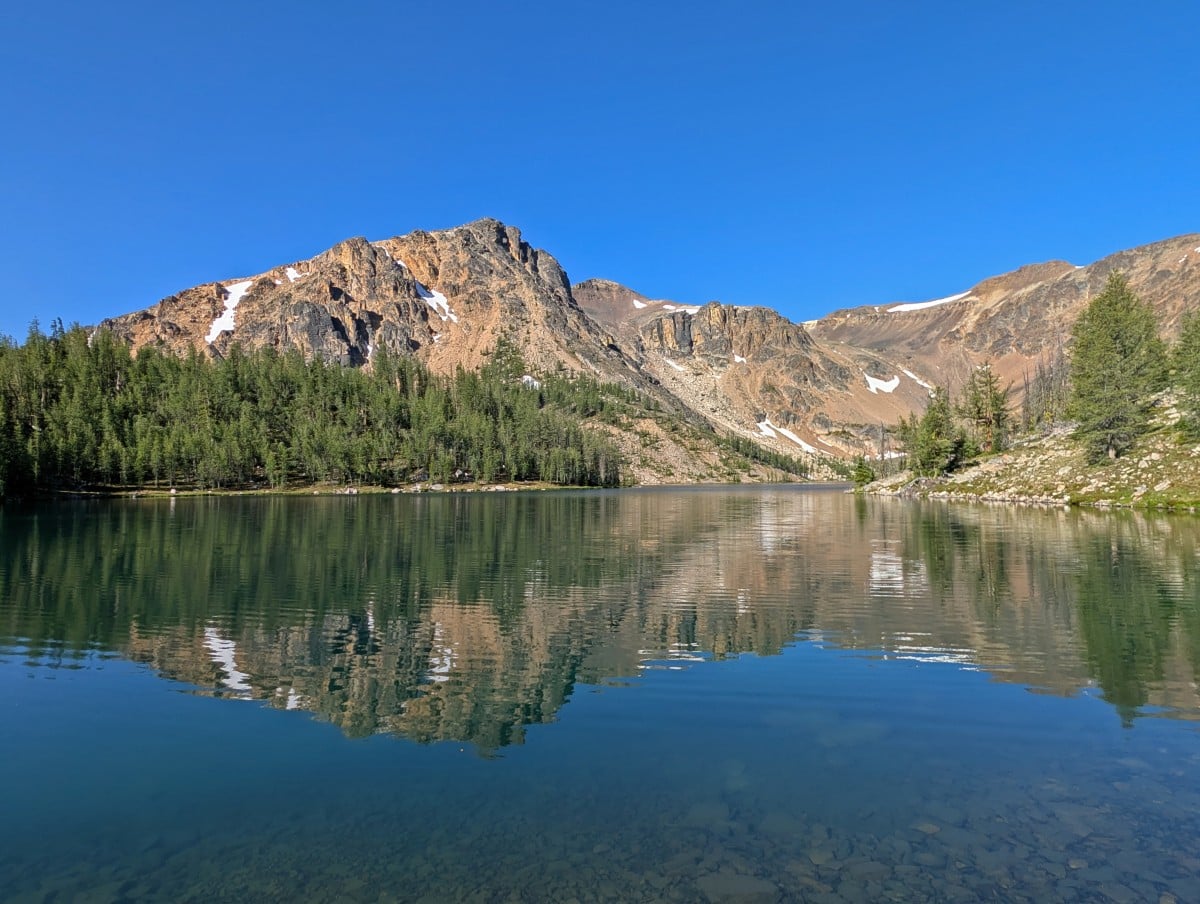
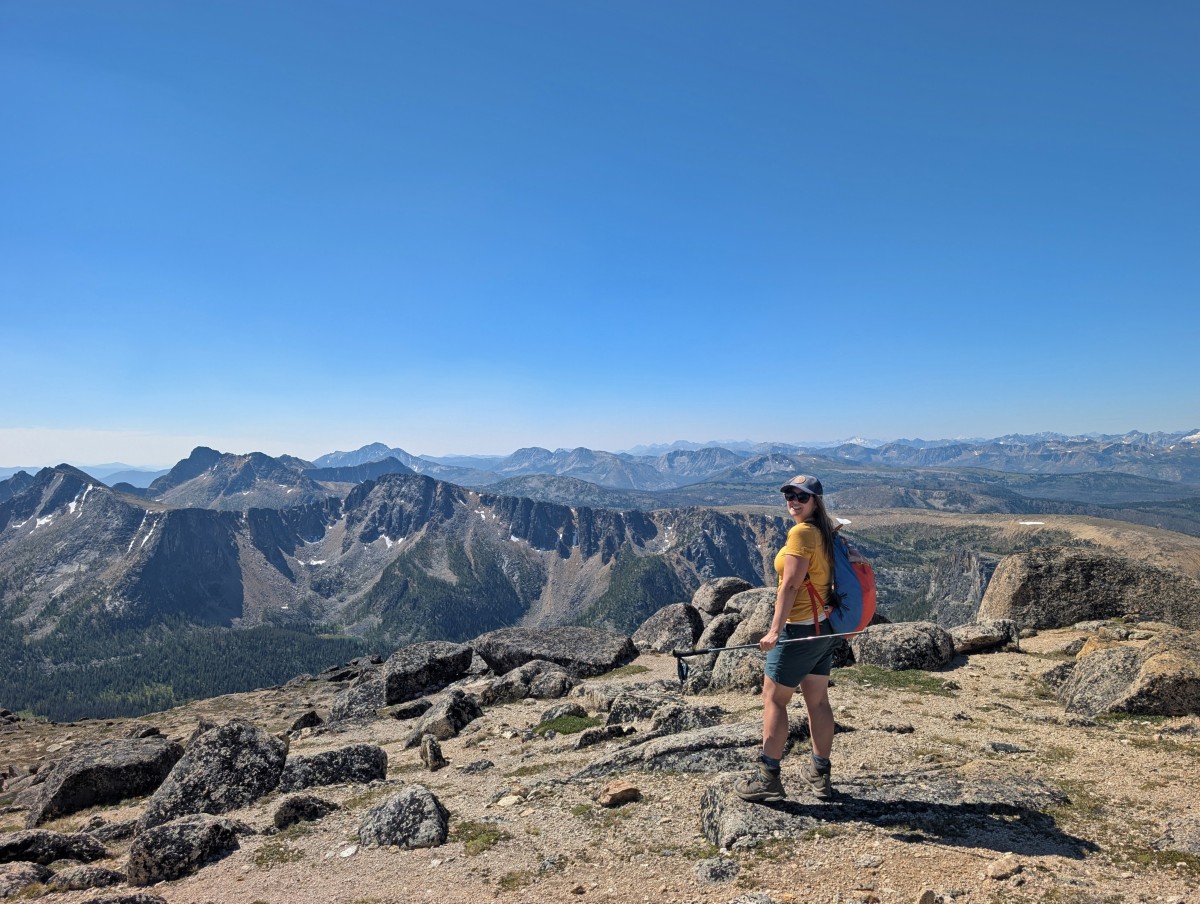
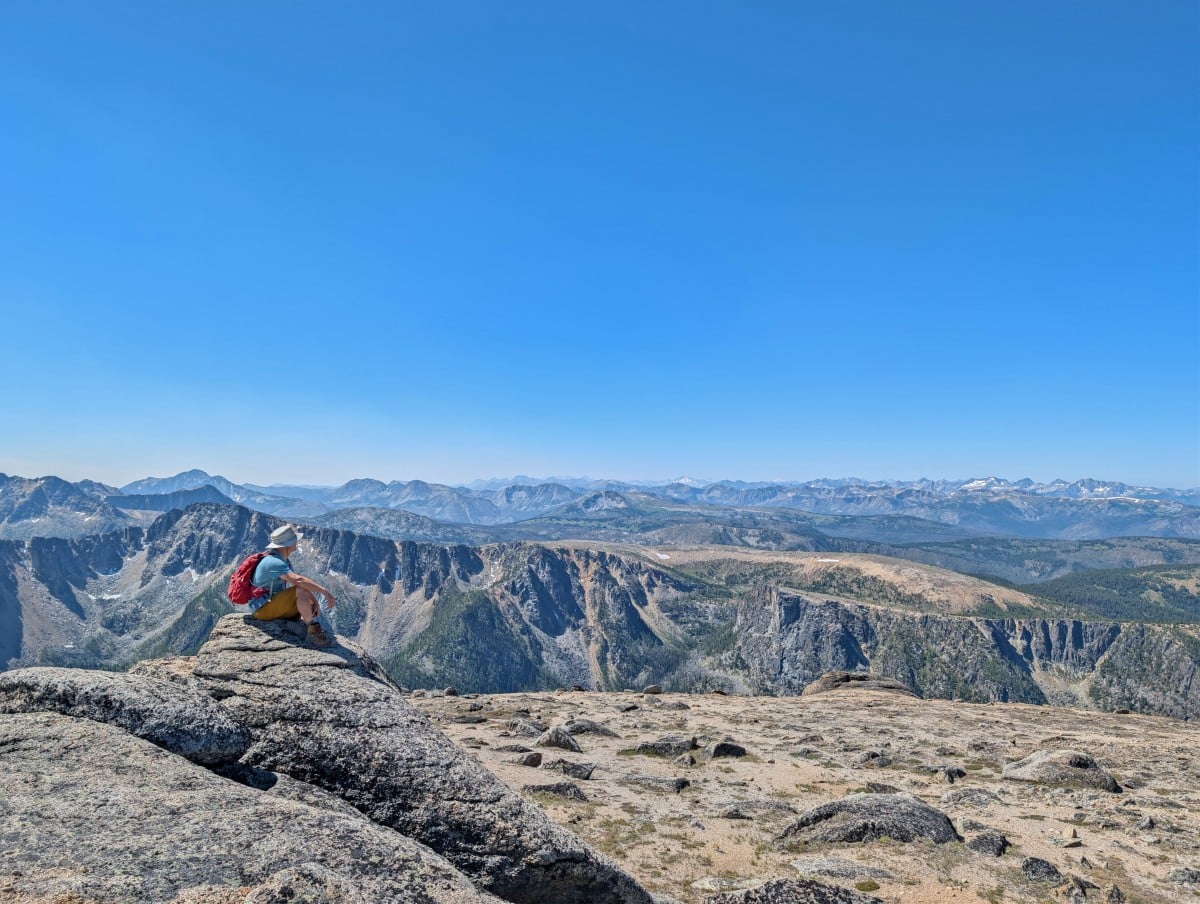
Spectacular views of surrounding mountain ranges abound, with a foreground of deep blue and turquoise coloured alpine lakes and interesting geological formations. The route passes several summits, making it easy to add a few peaks to your itinerary.
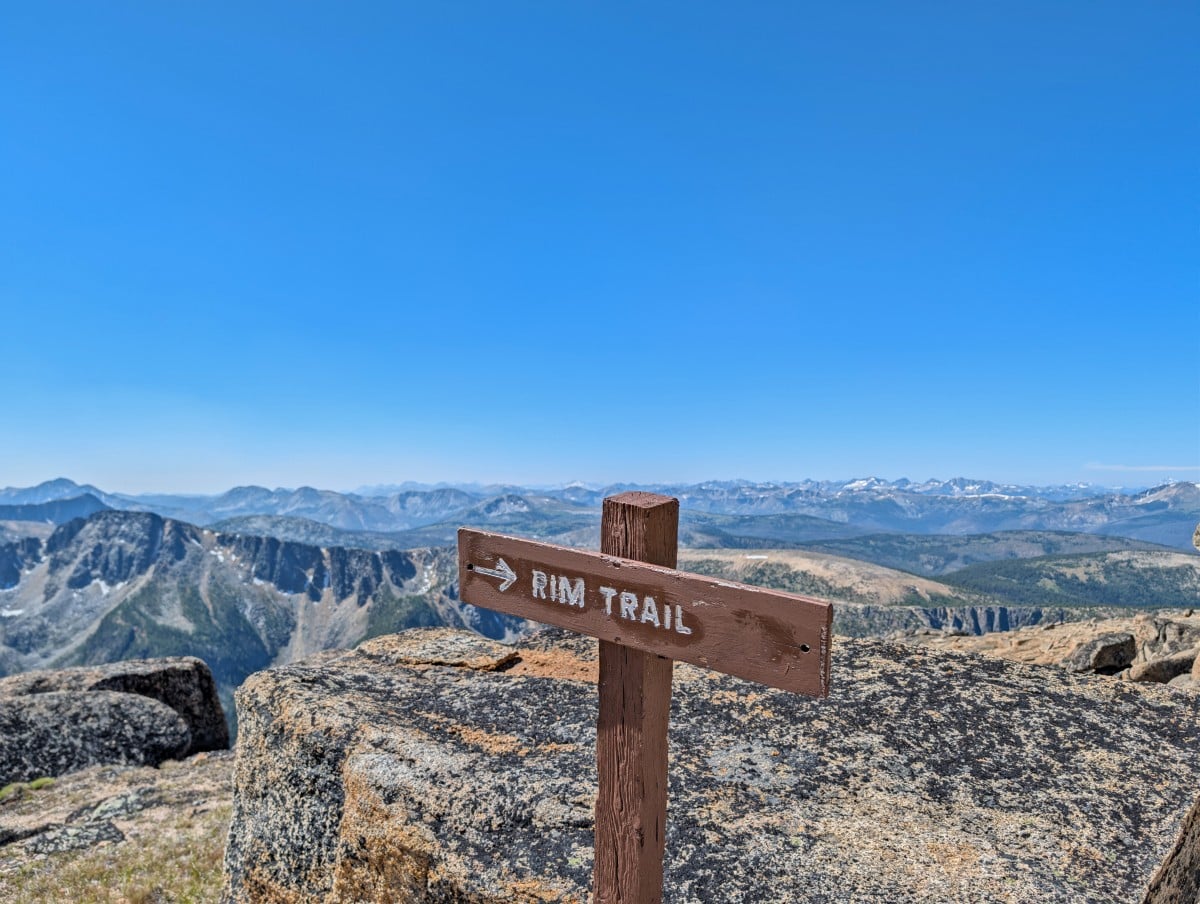
The kilometres pass by fast on the Rim Trail, where something beautiful seems to lie around every corner. There’s a good chance that you’ll get to see mountain goats too.
We have hiked the Rim Trail twice – both the full 17km route and a shorter, more approachable version. Our most recent visit came after the 2023 wildfire swept through the park, so we were curious to see how the trail had changed. Thankfully, the Rim Trail remains just as spectacular as ever!
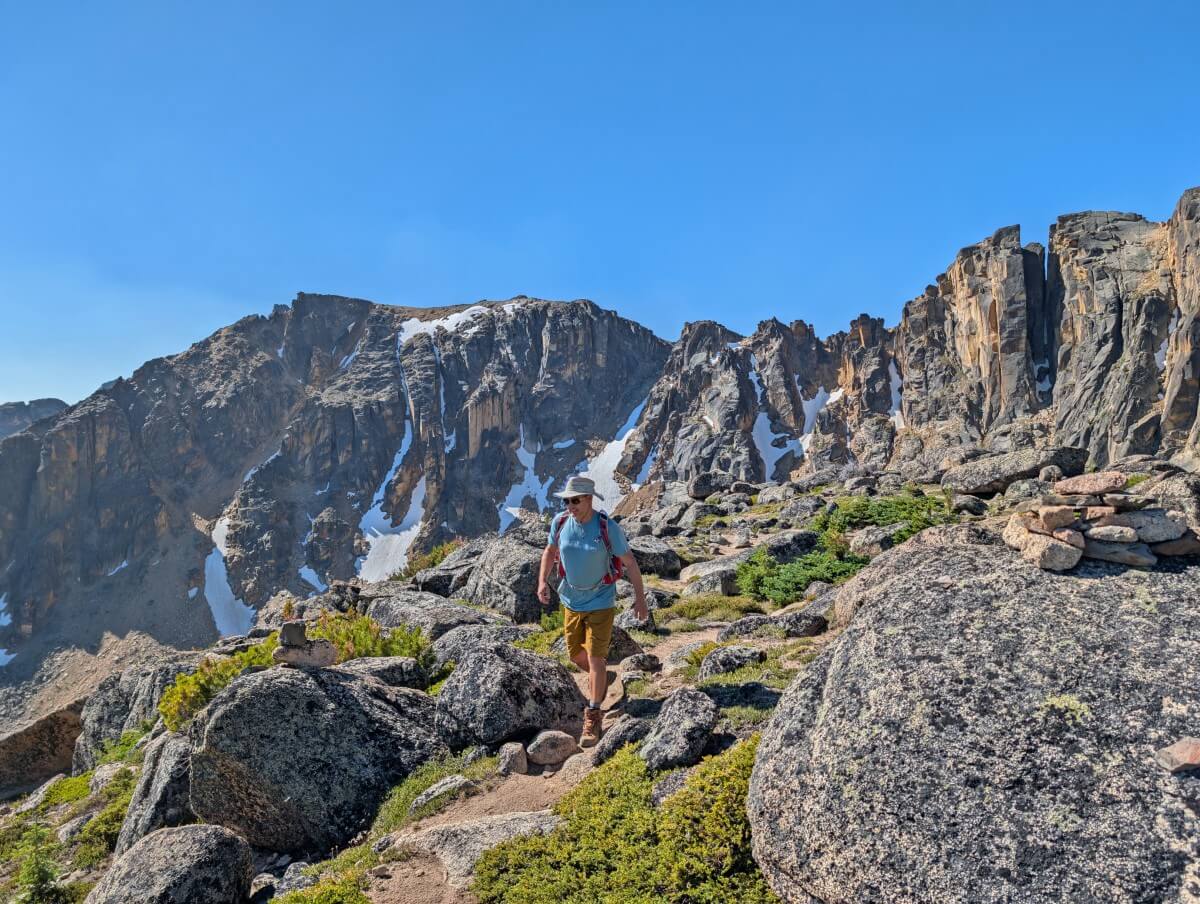
This post shares everything you need to know to plan a hike on the Rim Trail in Cathedral Provincial Park, including how to access the trailhead, when to go, navigation, the difficulty level, route options and more.
Rim Trail
Location: Cathedral Provincial Park near Keremeos, BC
Distance: 17km (shorter routes available)
Elevation gain: 900m for full circuit
Hike type: Loop
Time: 6 to 10 hours
Difficulty: Challenging
Camping: At Quiniscoe Lake
Fees: None
Dogs: Not permitted
Backcountry necessities
- Always bring the 10 Essentials
- Know how to stay safe in the backcountry
- Remember to Leave No Trace to help keep the wilderness wild
- Understand how to avoid negative bear encounters
- Trying out backpacking for the first time? Read Backpacking 101
- Check out our packing guide with gear recommendations
- Sign up to our newsletter for a free backpacking checklist
Introducing the Rim Trail
The Rim Trail is located in the core area of Cathedral Provincial Park, also known as ‘Cathedral Lakes.’ The name of the path refers to the mountainous ridge along the western side of Cathedral’s core area.
This ridge path is combined with Pyramid Lake Trail, Ladyslipper Lake Trail and the Centennial Trail to form a 17km loop route from Quiniscoe Lake. The latter is the location of the only backcountry campground in the core area as well as the privately owned and operated Cathedral Lakes Lodge.
Along the way, hikers are rewarded with 360 degree views of alpine lakes, endless mountain ranges and striking geological formations such as the basalt Giant Cleft and Smokey the Bear. The latter are visible from a short side trail near Stone City, a quartz monozonite formation.
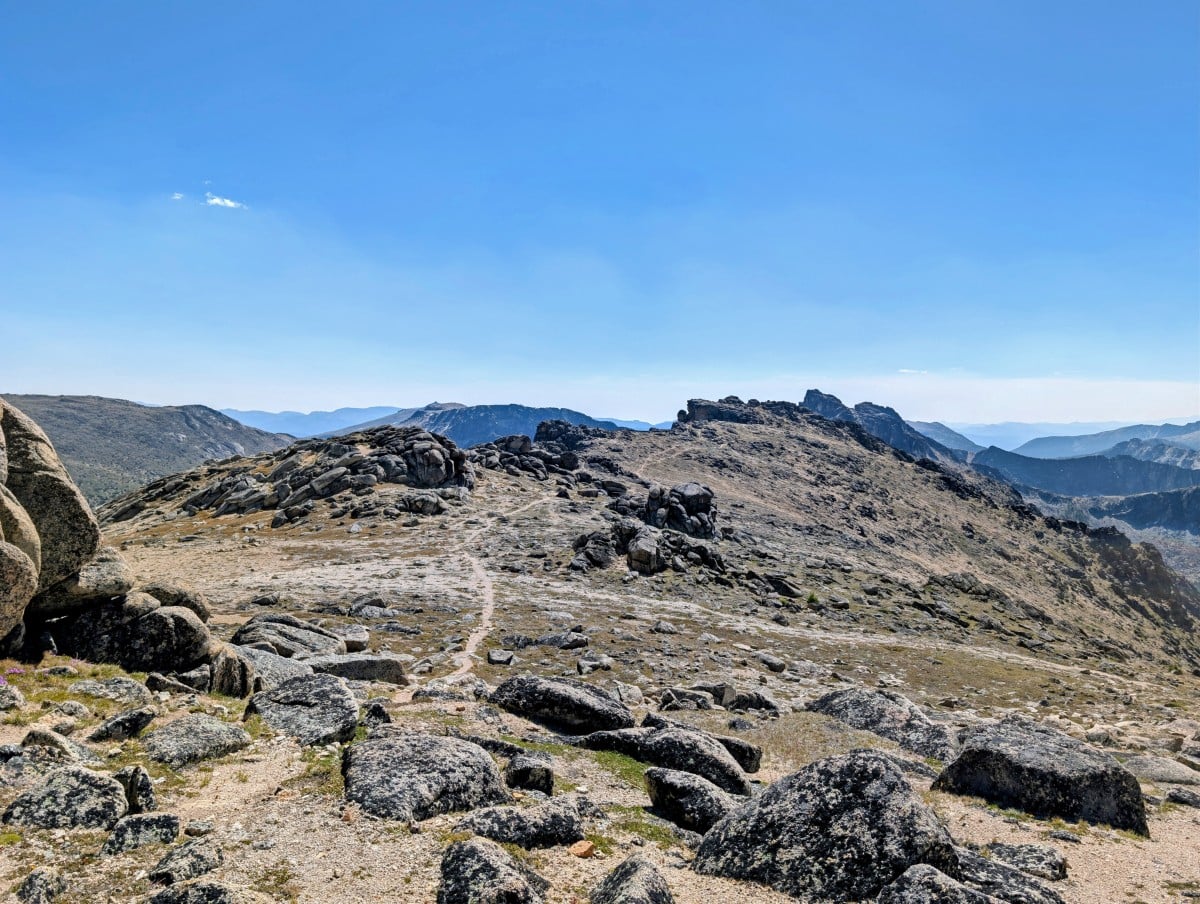
Most hikers travel the Rim Trail Loop in a clockwise direction, heading to Ladyslipper Lake first and finishing on the Centennial Trail north of Quiniscoe Lake.
There are a few shorter Rim Trail routes. Hikers can enter or depart the Rim via steep routes directly to Glacier Lake (11km loop with 650m elevation gain) or Quiniscoe Lake (13km loop with 770m elevation gain).
The Glacier Lake routing is the most popular option as it still includes the highlights (Ladyslipper, Stone City, Devil’s Woodpile) but skips the longest and most difficult sections (Quiniscoe Mountain area, Red Mountain).
Rim Trail map
The below map displayed our recorded route on the full Rim Trail.
We started at the Quiniscoe Lake Campground, hiked towards Pyramid Lake, then up to Ladyslipper Lake, ascend to Stone City, detoured towards Smokey the Bear, then back through Stone City along the Rim to Devil’s Woodpile, summited Quiniscoe Mountain, continued to Red Mountain and then back to Quiniscoe Lake via the Centennial Trail.
About Cathedral Provincial Park
Cathedral Provincial Park is a lesser-known protected area situated between the Okanagan Valley and Manning Park in British Columbia, Canada. The southern boundary of the park meets the US border. This is the traditional territory of the Lower Similkameen Indian Band.’
The village of Keremeos is the nearest community to Cathedral, about 40km to the east of the main access point. Be sure to visit after your hike to stock up on the best fresh fruit in BC! Keremeos is about five hours drive from Vancouver and nine hours from Calgary.
Our experience hiking the Rim Trail
We’ve hiked the Rim Trail twice. On our first visit to Cathedral, we stuck to the shortened version and visited Ladyslipper Lake, ascended to the Rim, explored the Stone City and then descended via Glacier Lake. It was one of the biggest hikes we ever done at the time.
On our first visit, we were most impressed with the Stone City area – I described it as ‘a giant’s playground with rocks of every size thrown about everywhere.’ We didn’t see many people that day and loved the solitude. Sadly, we didn’t see any mountain goats either.
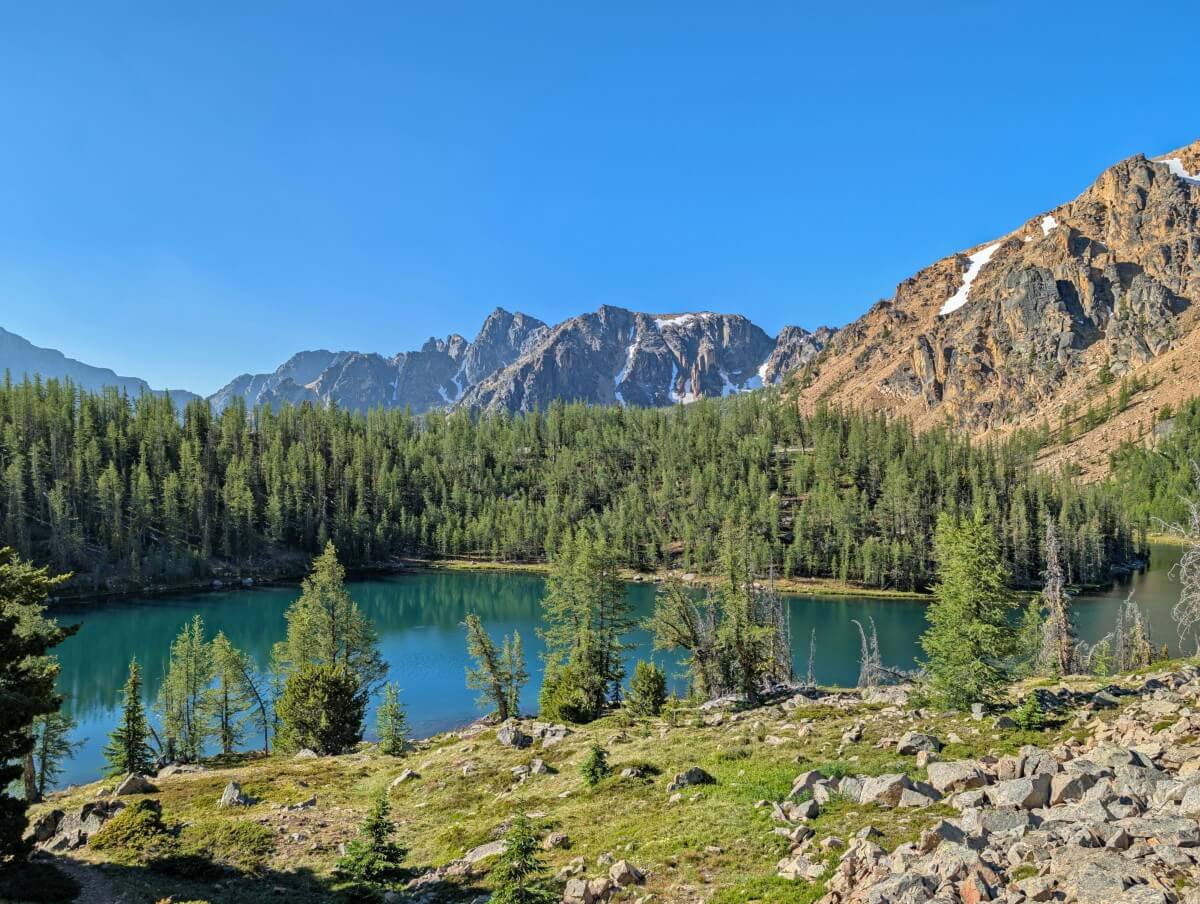
We returned in late July 2026, the first year Cathedral was accessible by shuttle again after the 2023 Crater Creek wildfire. This time (and with much more hiking experience), we took on the complete circuit.
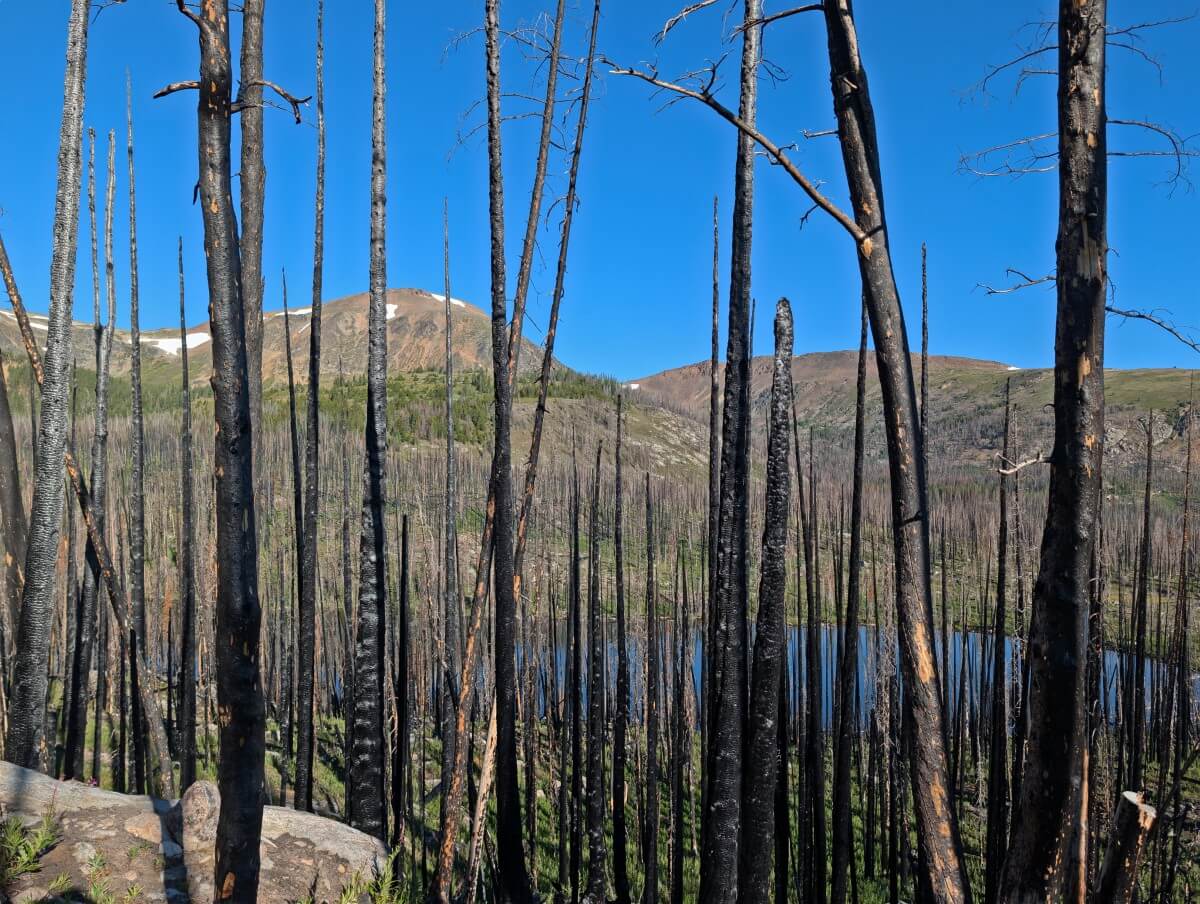
The first few kilometres, marked by burned trees and damaged bridges, were extremely sobering. But as we climbed towards Ladyslipper Lake, I was relieved to reach a living larch forest.
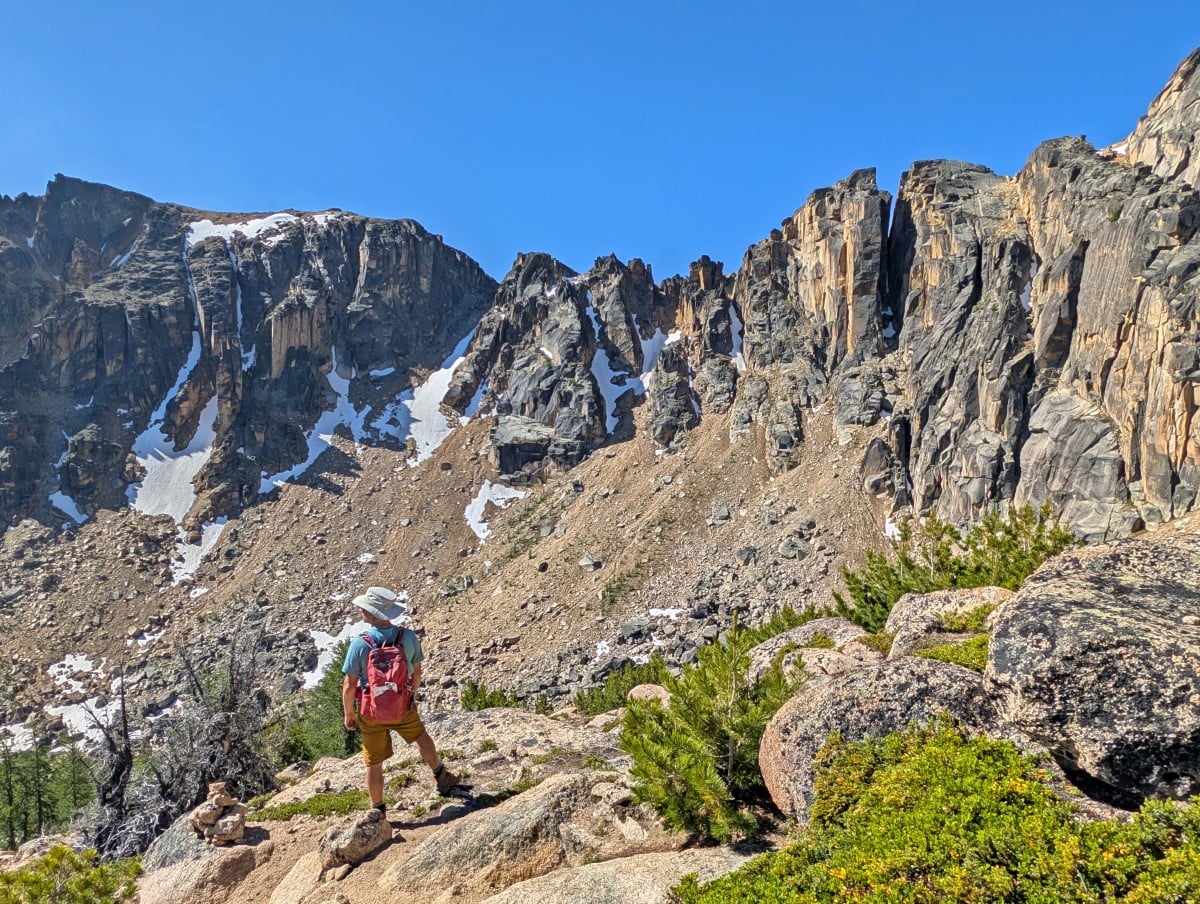
Just 200 metres elevation higher than Quiniscoe Lake, the landscape returned to what it was on our first visit.
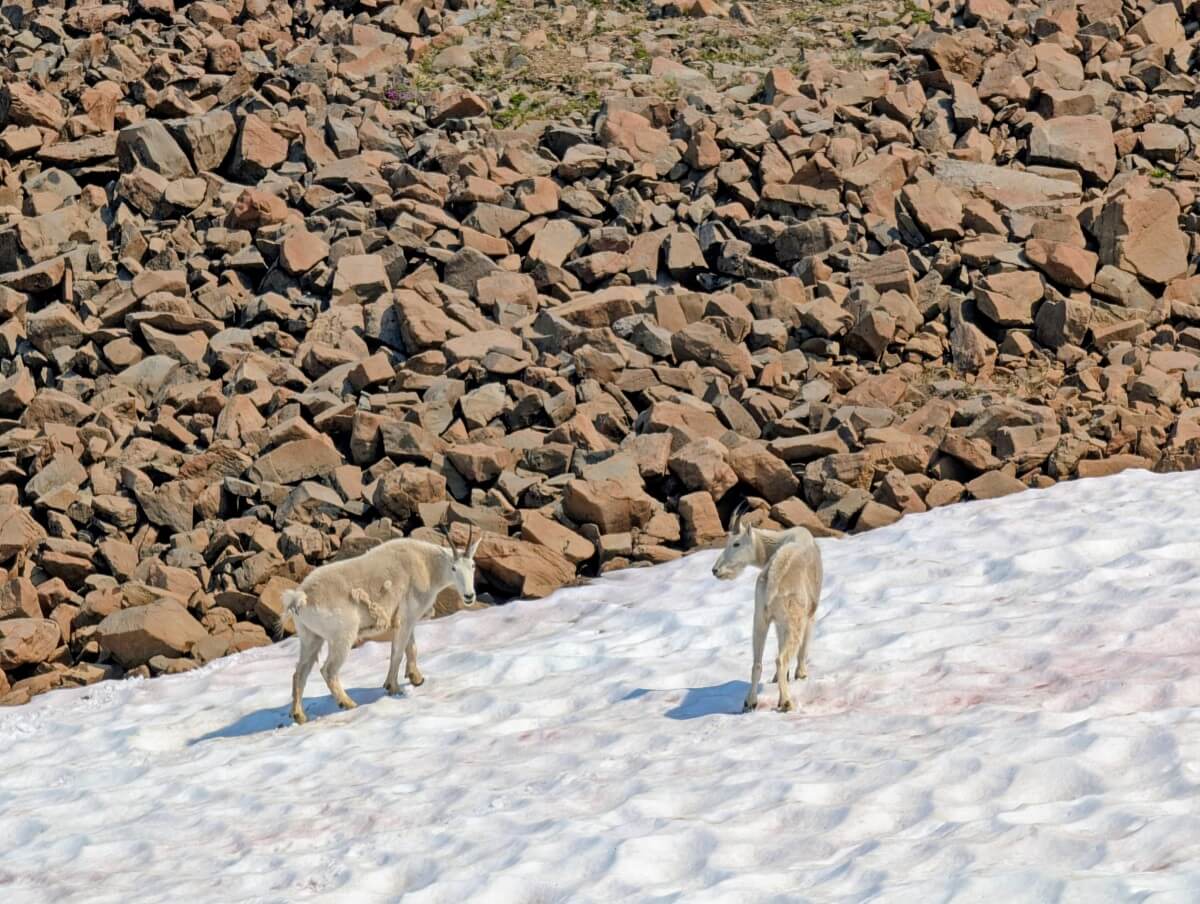
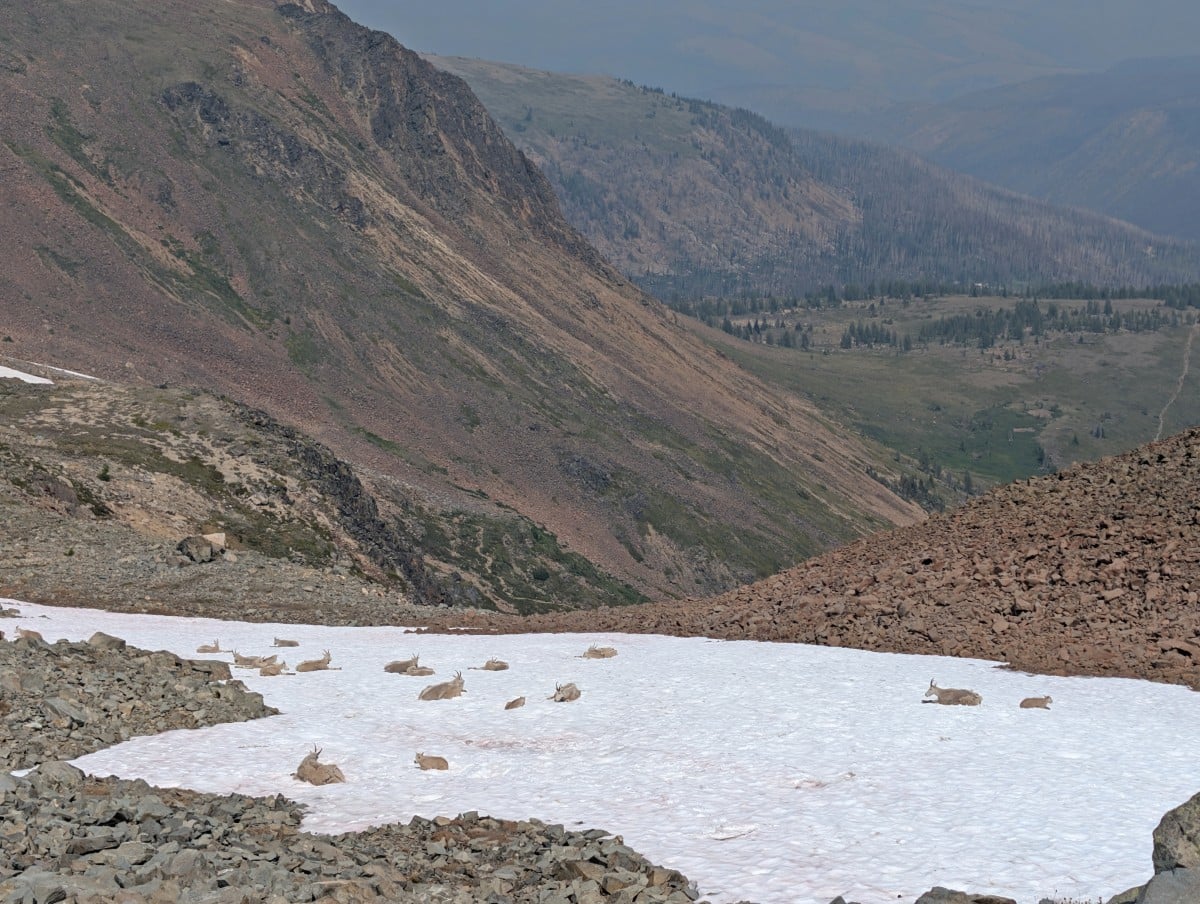
It was a full day of hiking and, again, we only saw a handful of people. This time, however, we spotted a herd of mountain goats hanging out on a patch of snow by Quiniscoe Mountain. They were clearly as hot as us – it was around 30°C that day!
Around this time, wildfire smoke also rolled in from Washington. It significantly impacted the air quality and, unfortunately, the views as well. So while we were excited to explore beyond where we turned off last time, the experience wasn’t quite what it should have been.
Traversing Red Mountain’s boulderfields was also harder than I anticipated and we were both pretty tired as we descended down to Quiniscoe Lake from the Centennial Trail. We immediately jumped into the lake after reaching the campground!
Rim Trail hiking guide
In this section, I’ll share everything you need to know to start planning your hike on Cathedral Provincial Park’s Rim Trail.
This post includes affiliate links. If you make a qualifying purchase through one of these links, we may receive a small percentage of the sale.
How to access the Rim Trail
There is no public road access to the trailhead of this hike. Rim Trail hikers must first travel from the Cathedral Provincial Park boundary into the core area of the park.
There are two ways to do this:
- Hike one of three strenuous access trails (full day)
- Take the Cathedral Lakes shuttle bus (one hour)
The most used trail into the core area is the Lakeview Trail. It is 16km long with an elevation gain of 1300m. We hiked this trail back down to our vehicle after our most recent Cathedral trip. Following the fire, it has very little shade for the entire length. Certainly a slog on a hot day!
To save time and energy, most Rim Trail hikers take the Cathedral Lakes shuttle bus to and from the core area. For the 2026 season, the return fee is $168/adult and $84/child (4 to 12 years old). Reservations are available online.
There are two shuttles up and down every day – 10am and 4pm (up) and 9am and 3pm (down). Due to these timings, the majority of hikers will take the shuttle up and then plan to hike the Rim Trail another day.
Staying for three nights gives you some flexibility to choose the best day for the Rim Trail, which is particularly useful in the alpine where weather conditions can change quickly and dramatically. We’ve experienced some pretty extreme weather changes in Cathedral – 25°C one day and snow the next.
If camping isn’t your thing and you don’t have the budget for the lodge, it’s still possible to explore part of the Rim Trail on a day trip if you take the first bus up and are a strong hiker. It wouldn’t give you long (less than 4 hours) but you’d be able to get a taste of its beauty.
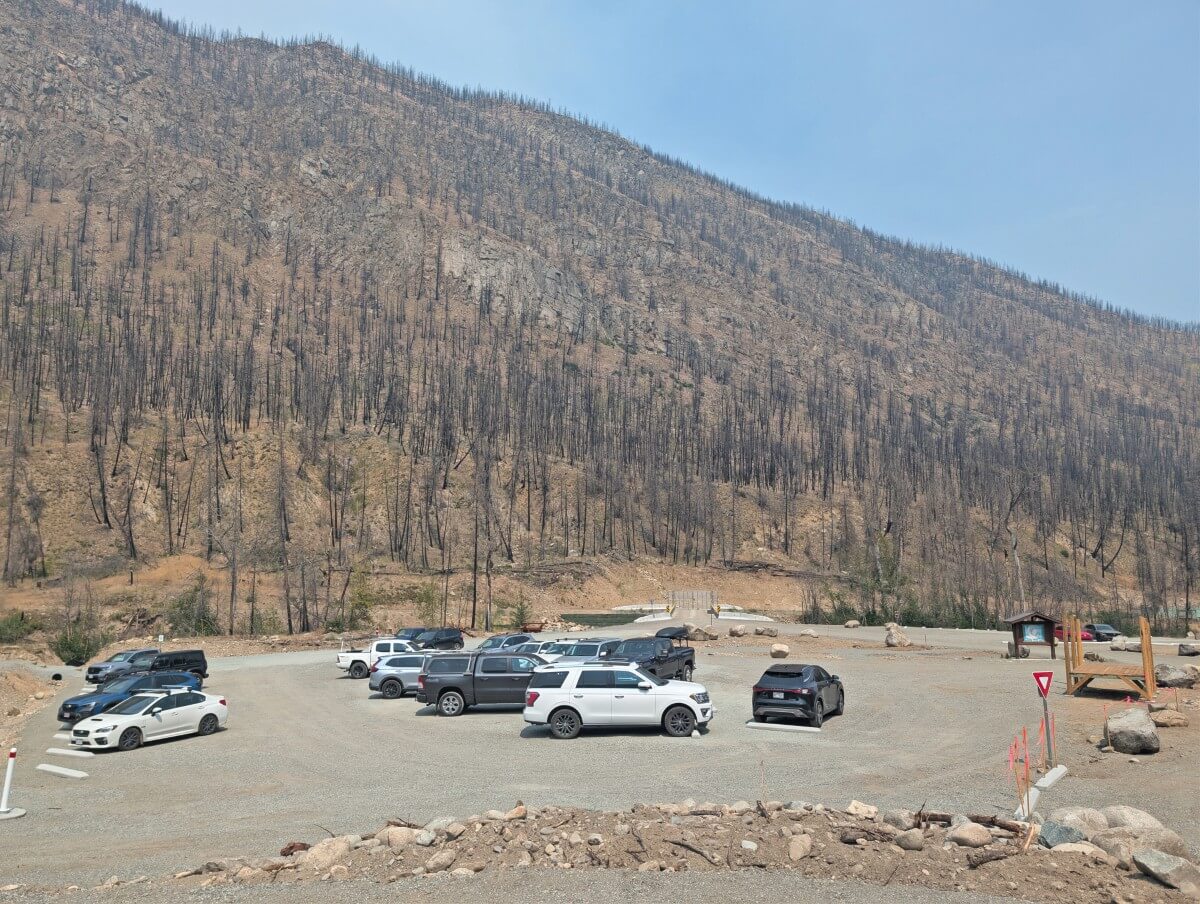
Trailhead parking
The main access point of Cathedral Provincial Park is on Ashnola River Road near the village of Keremeos. Head west on Highway 3 and turn at the signed junction, crossing the big red bridge over the Similkameen River.
Continue on this road. It becomes unpaved after a time but is fairly well maintained. There are many paid and free riverside campgrounds along the road.
The Cathedral Lakes Lodge shuttle parking lot is 21km along the Ashnola River Road. The gate may be locked when you arrive but it will be opened when the shuttle arrives.
If you’re not taking the shuttle, continue along Ashnola River Road to the Lakeview Trailhead or Wall Creek Trailhead (also known as the Centennial Trail).
Rim Trail hiking experience overview
Being a circuit, it is possible to hike the Rim Trail clockwise or counter-clockwise. We hiked clockwise both times, to be able to explore Stone City and the other rock formations early on in the day.
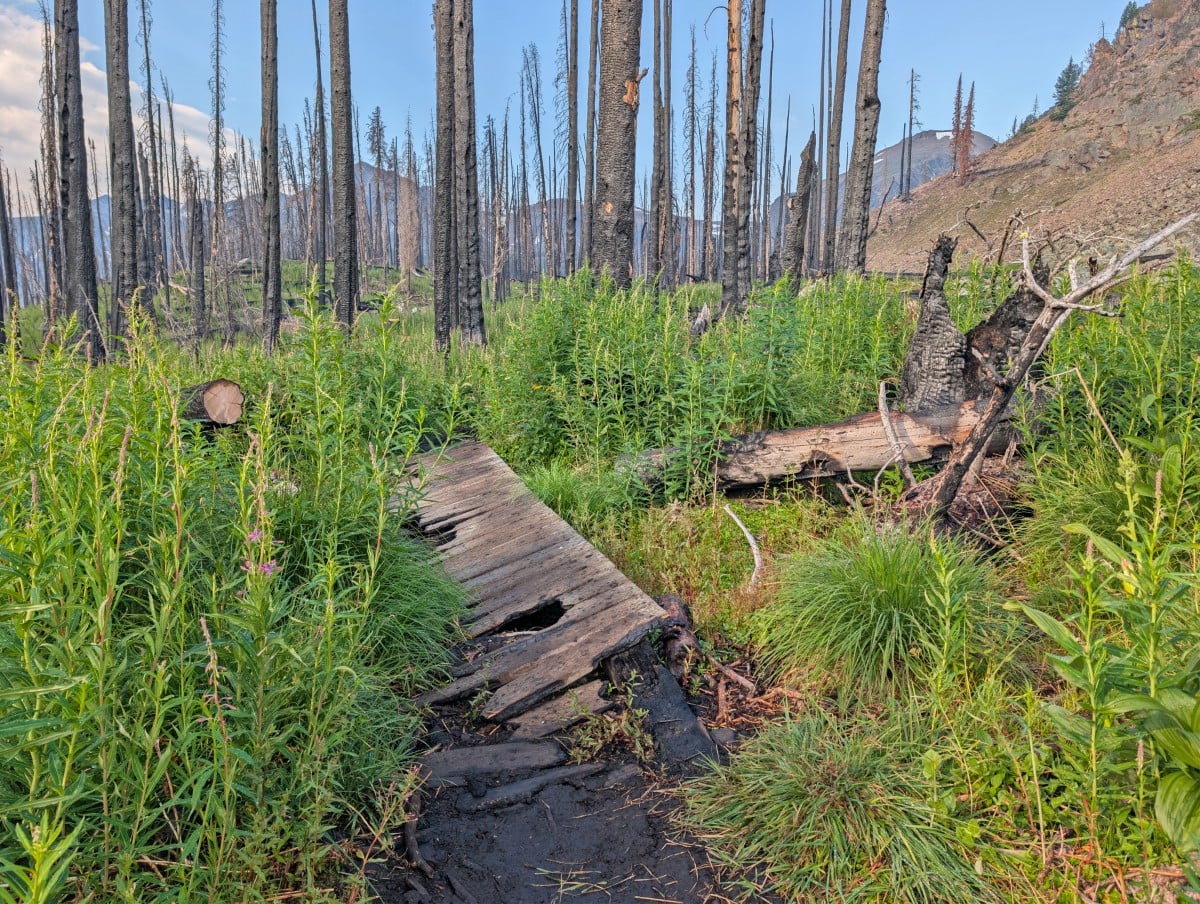
Start at the Quiniscoe Lake Campground and then head towards Pyramid Lake. This section of trail travels through entirely burned forest. The ground is dusty, bridges are gone and there’s very little signage. On the upside, the surrounding mountains are visible!
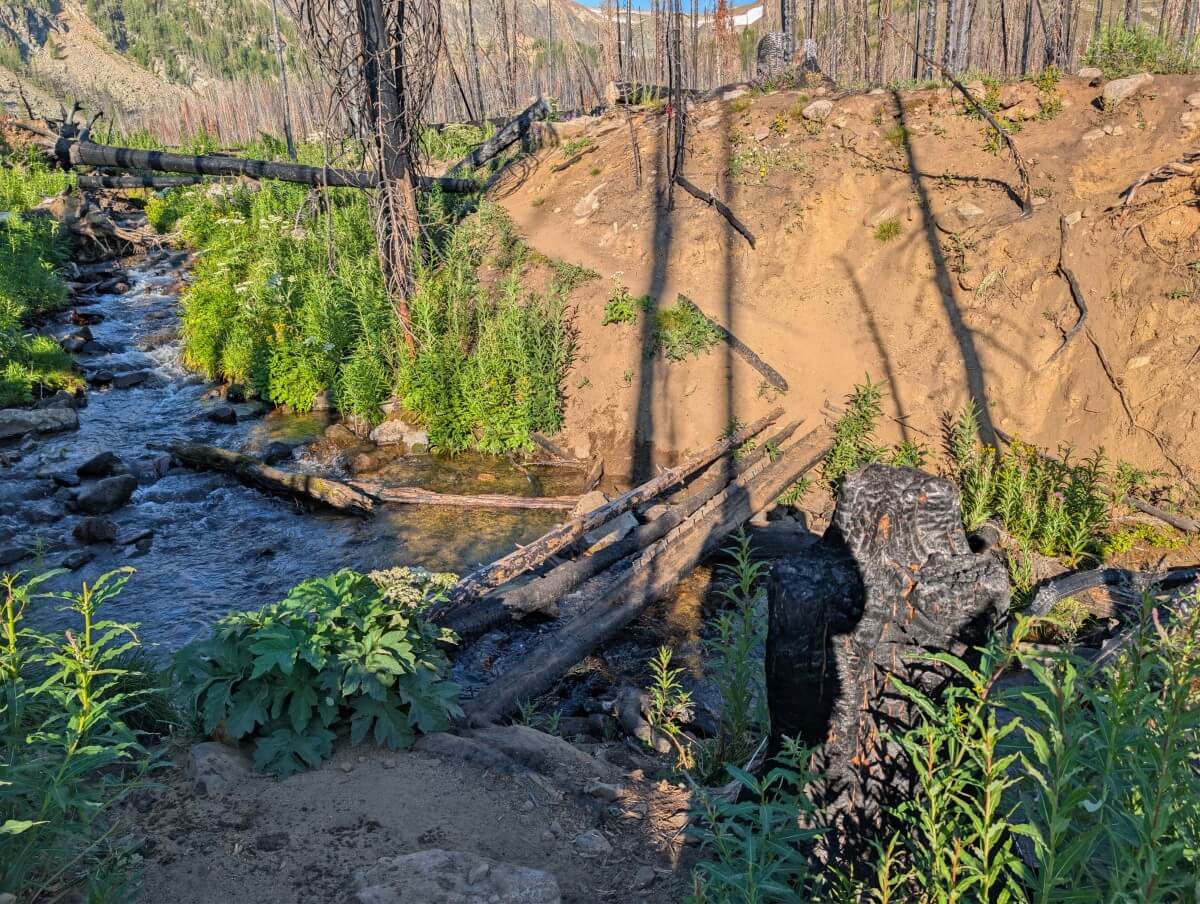
Look for a right hand turn at a junction about 200m after passing Pyramid Lake – it is not marked. This is the start of the uphill stretch to Ladyslipper Lake.
The trail initially switchbacks through burned forest before reaching a beautiful stand of larches. There are a couple of steeper sections, with the total elevation gain being 200m in about 1.2km.
The trees eventually open up and you’ll find yourself on a plateau, overlooking some of the peaks of the Cathedral Rim.
Gorgeous Ladyslipper Lake, usually sparkling turquoise in the sun, lies just downhill. Take a quick dip or continue along the lakeshore alongside more larch trees.
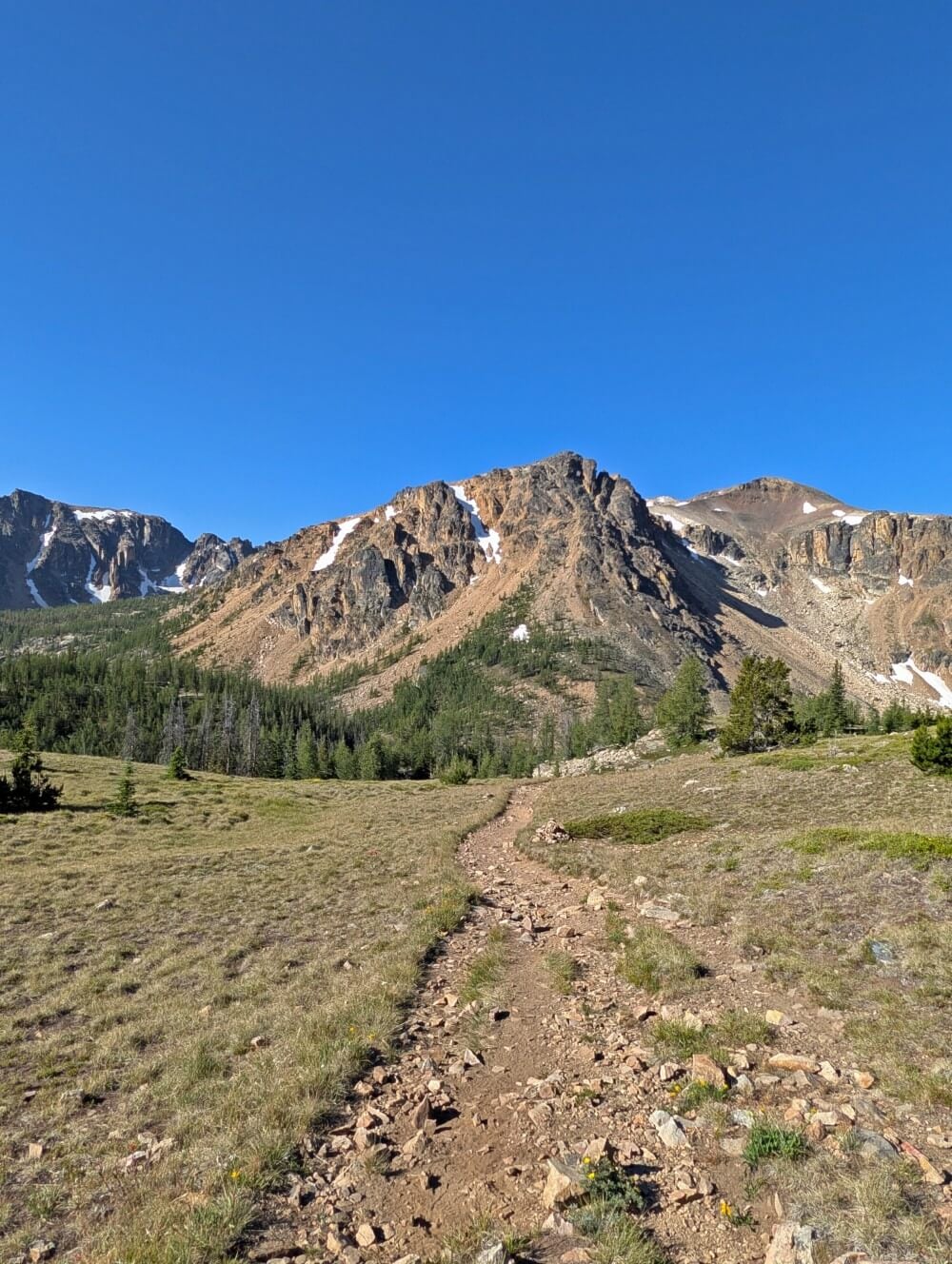
Ladyslipper Lake to Stone City
Don’t miss the junction on the southern side of the lake, by the water outlet. It can be easy to miss. The trail leads away from the lake, initially downhill and then steadily uphill, traversing a dirt and rock slope.
There are many different paths through the rocks here, with, again, some sections being steep. Expect another 200m elevation gain within 1.2km. On the left, impressive views of the Cathedral Rim appear – a great incentive to keep climbing!
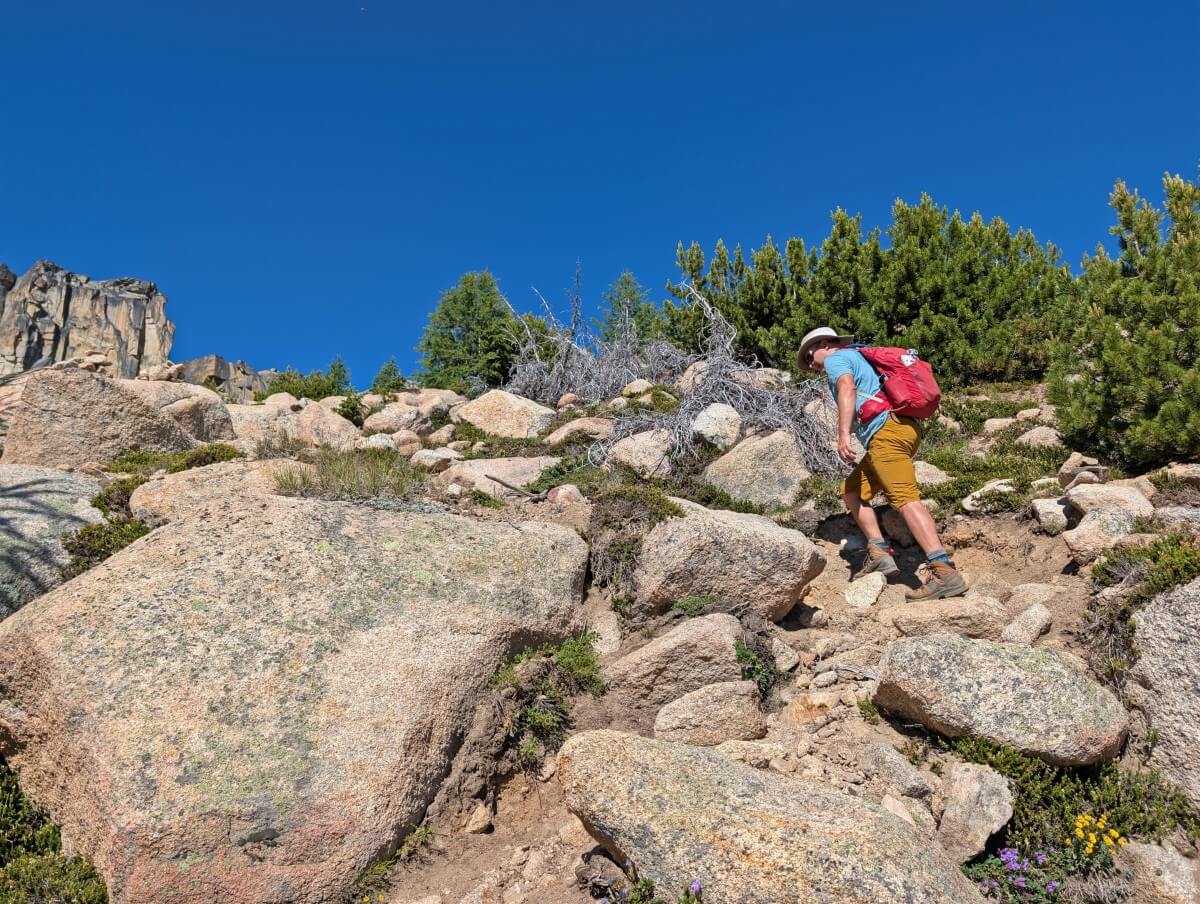
Eventually, the gradient mellows out and the trail arrives onto another plateau area with very few trees. The path ahead is well defined as it continues to slowly climb up towards the Rim (another 80m elevation gain over 600m).
Enjoy the views of the rock formations before heading up to the final ascent, which is a short but steep climb (80m elevation gain in 300m) up a scree slope with a drop on both sides. I’m not great with heights, drops OR scree but it is over very quickly.
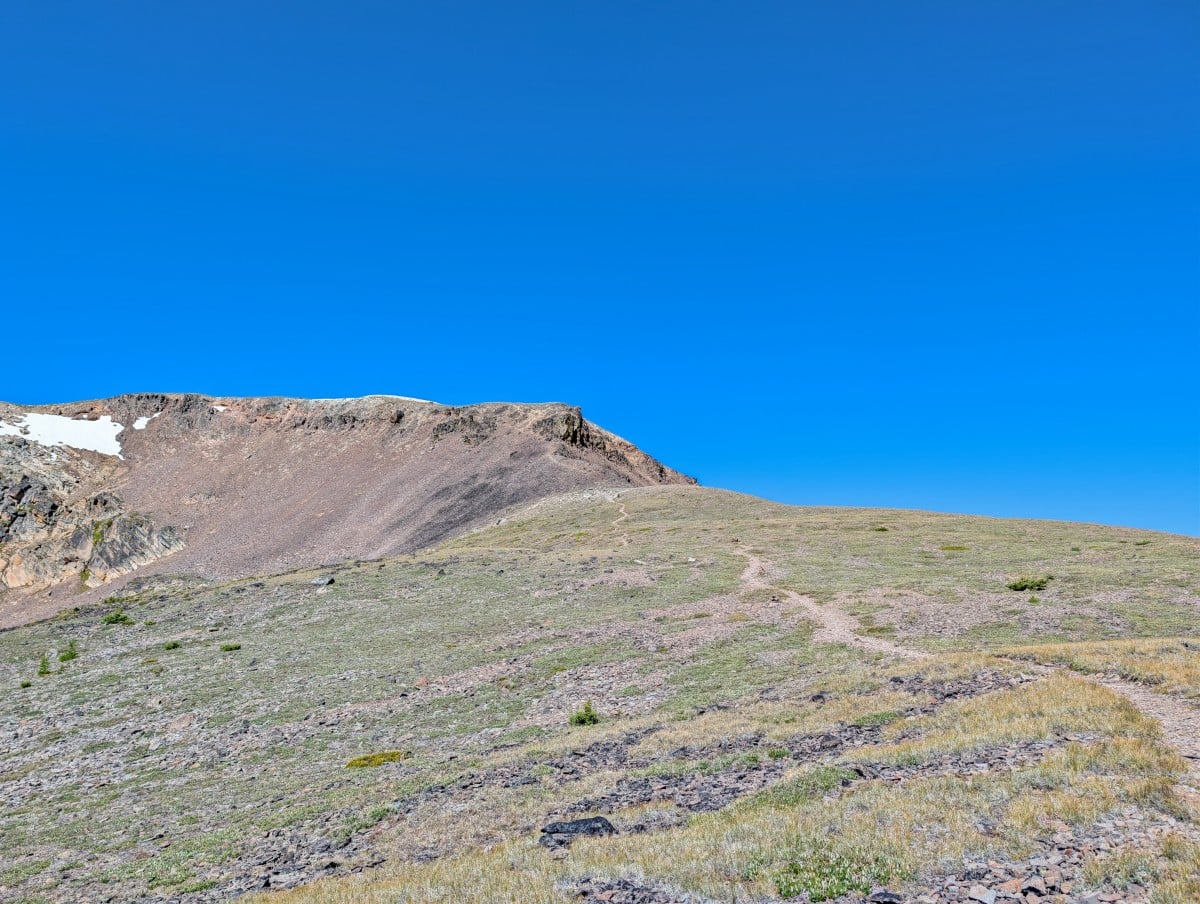
A Stone City sign heralds your arrival on the Rim. Turn left to explore more of Stone City, Smokey the Bear and the Giant Cleft or right to continue along the Rim.
We enjoy checking out Smokey the Bear and going a little further (about 1km) but then after that the trail gets a bit steep with some big drop-offs.
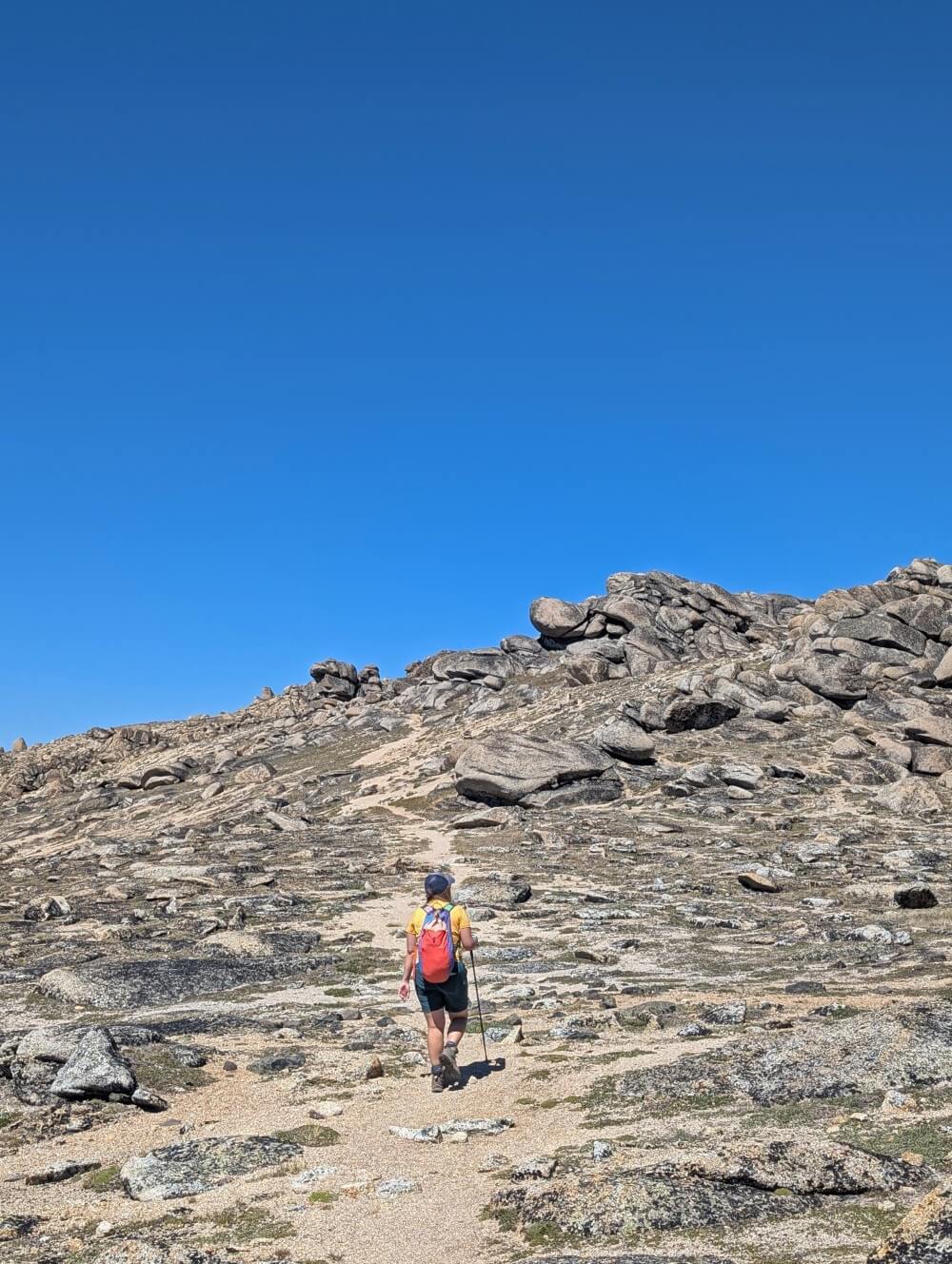
Stone City to Quiniscoe Mountain
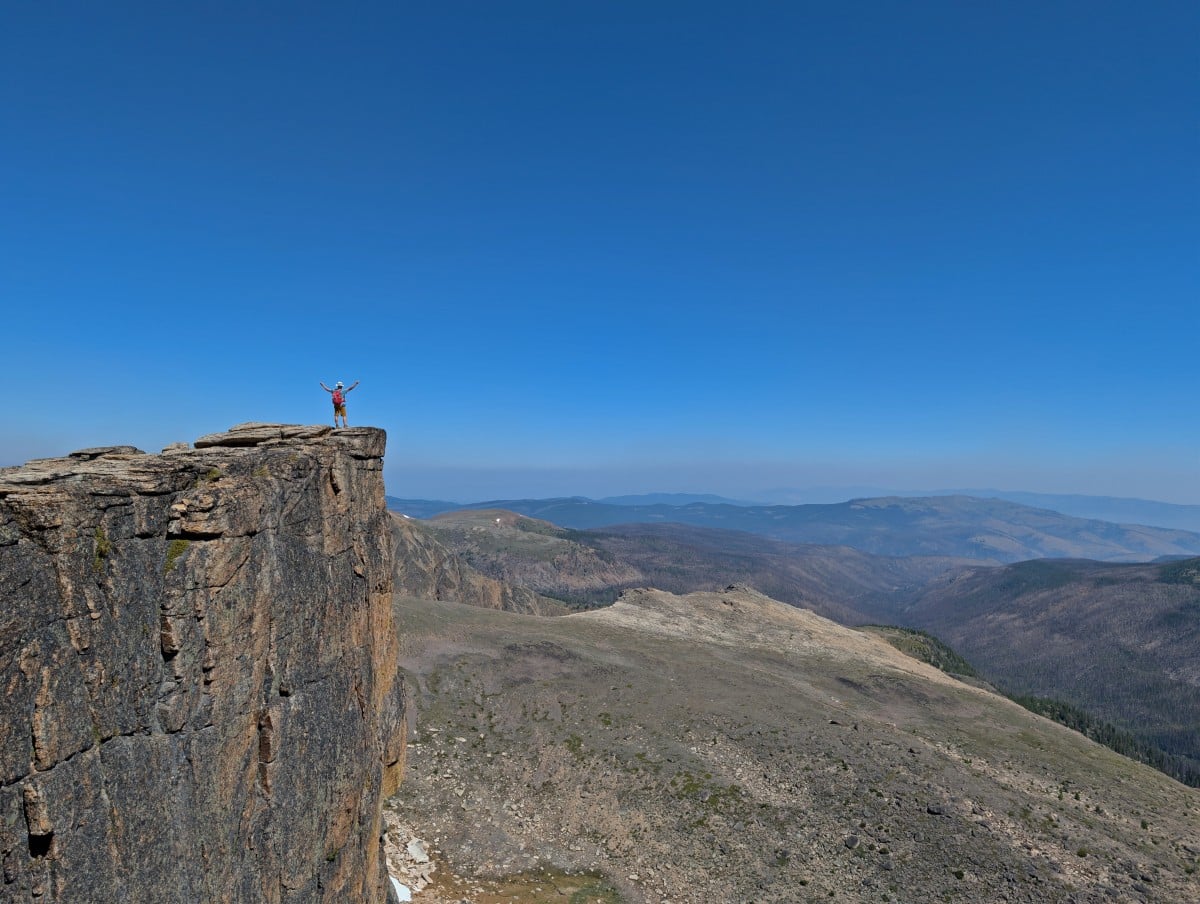
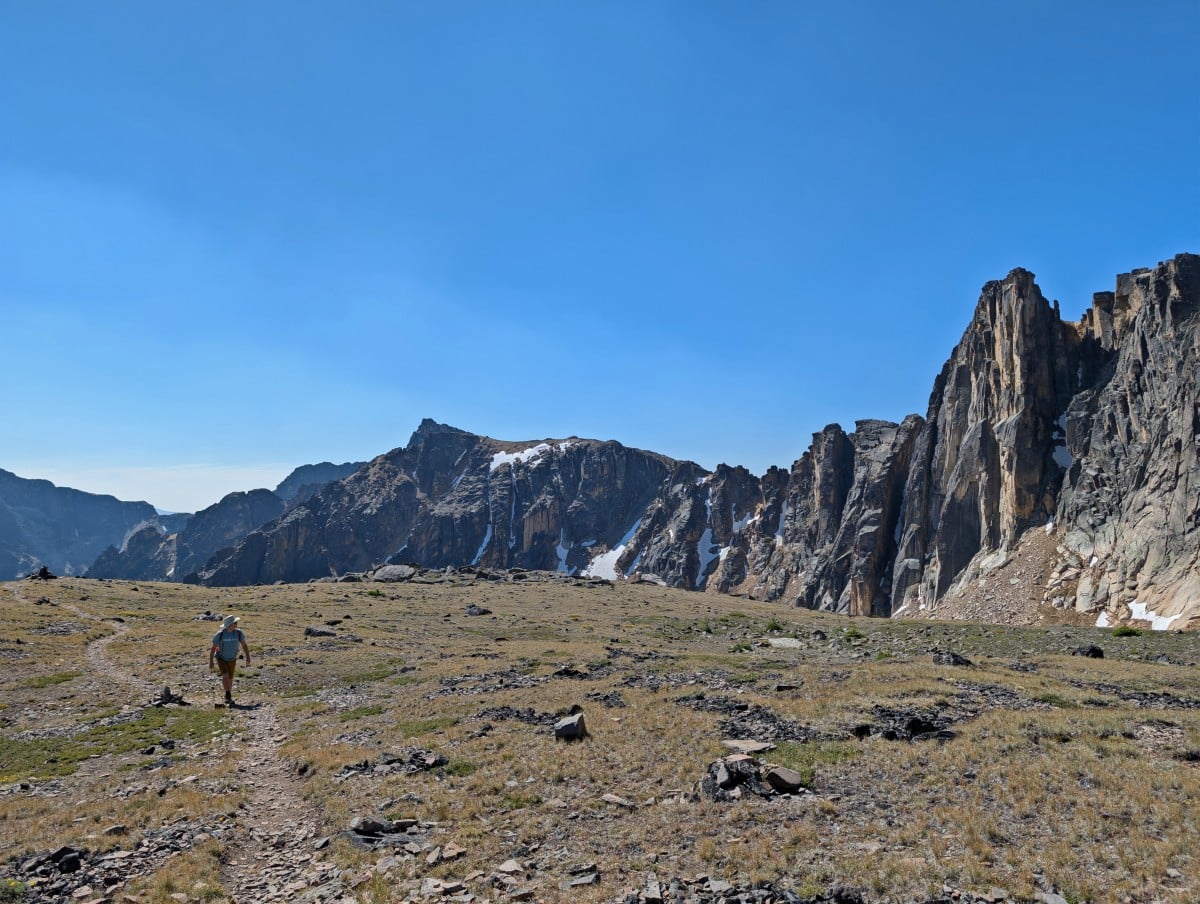
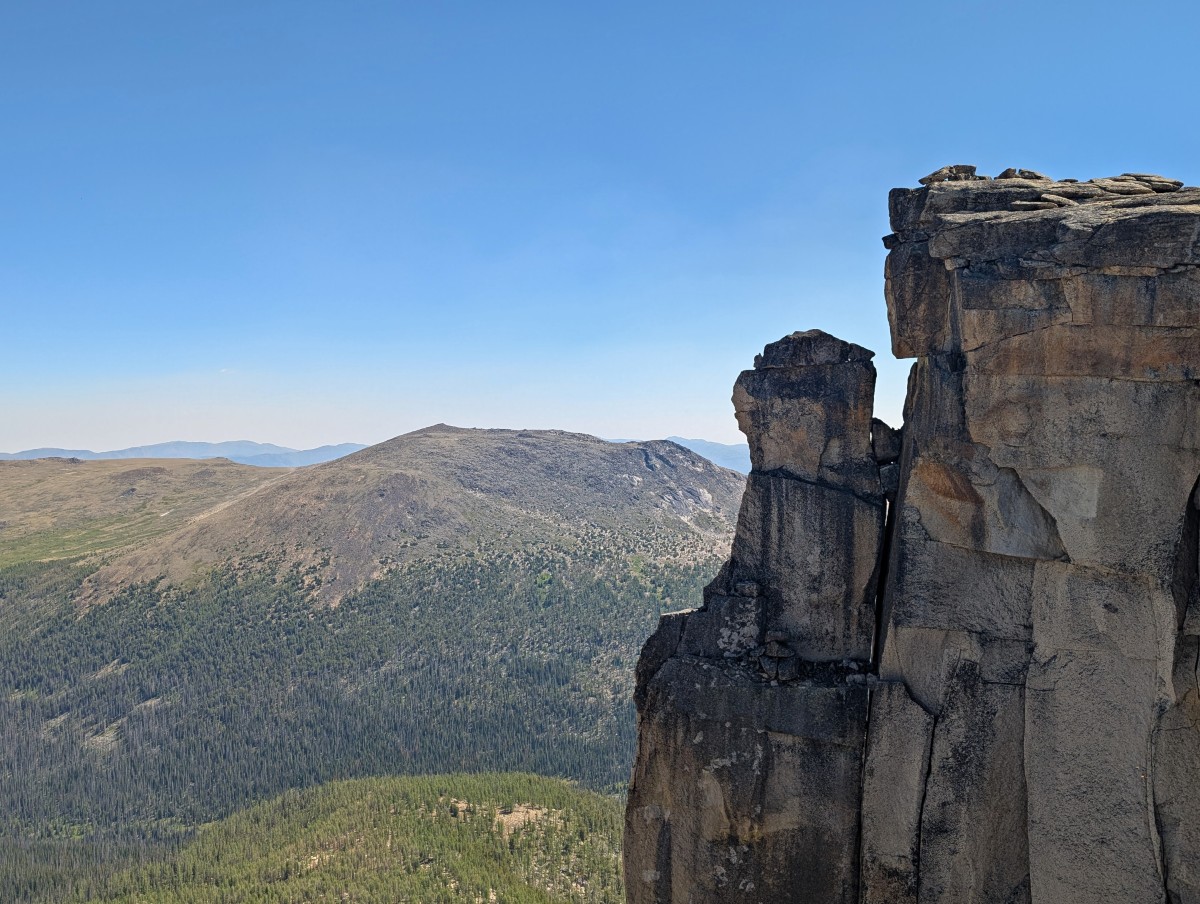
The views of the surrounding mountain ranges on this section of the Rim Trail are spectacular. Don’t rush away – take a break on one of the many rock formations in this area and enjoy.
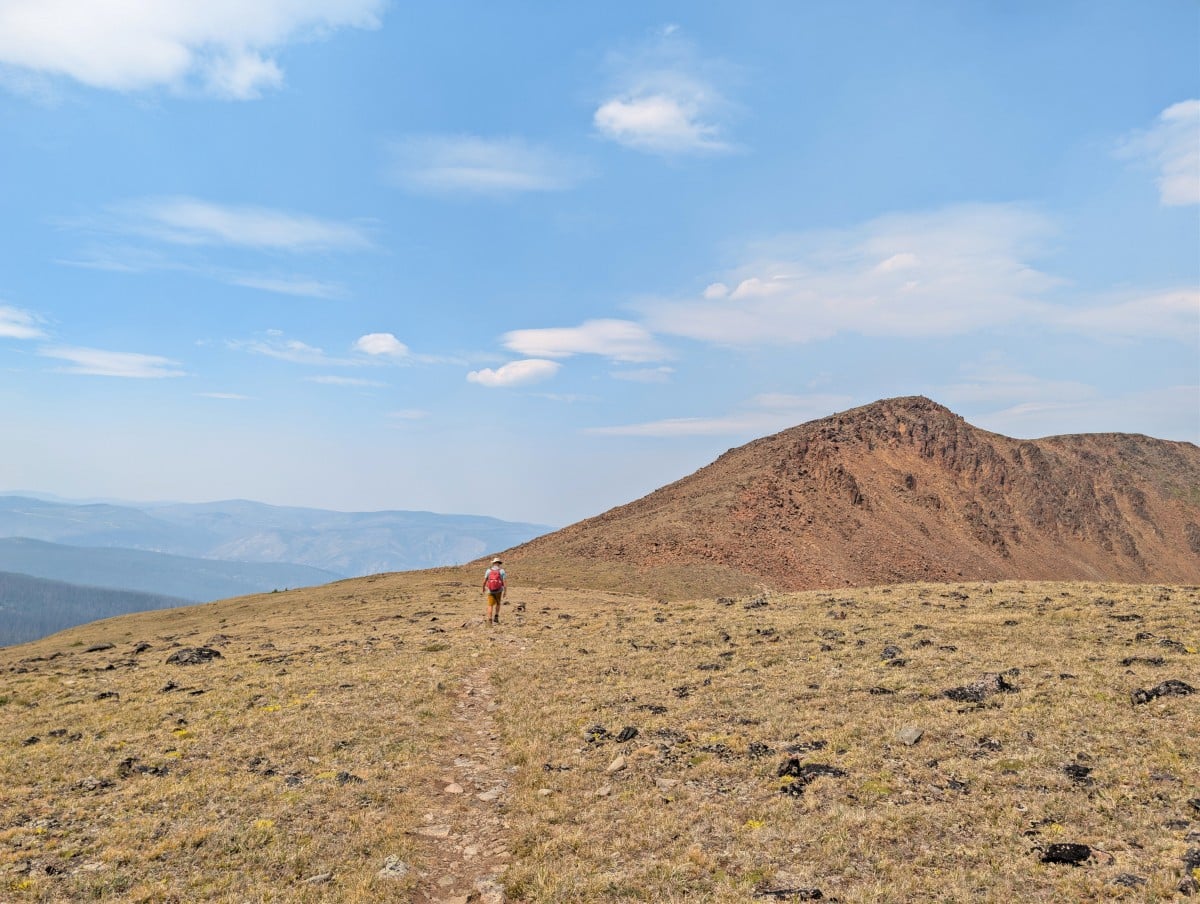
The next stretch of the Rim Trail is pretty straightforward – there are no trees, so the trail is visible in the distance. There’s only minimal elevation gain as well.
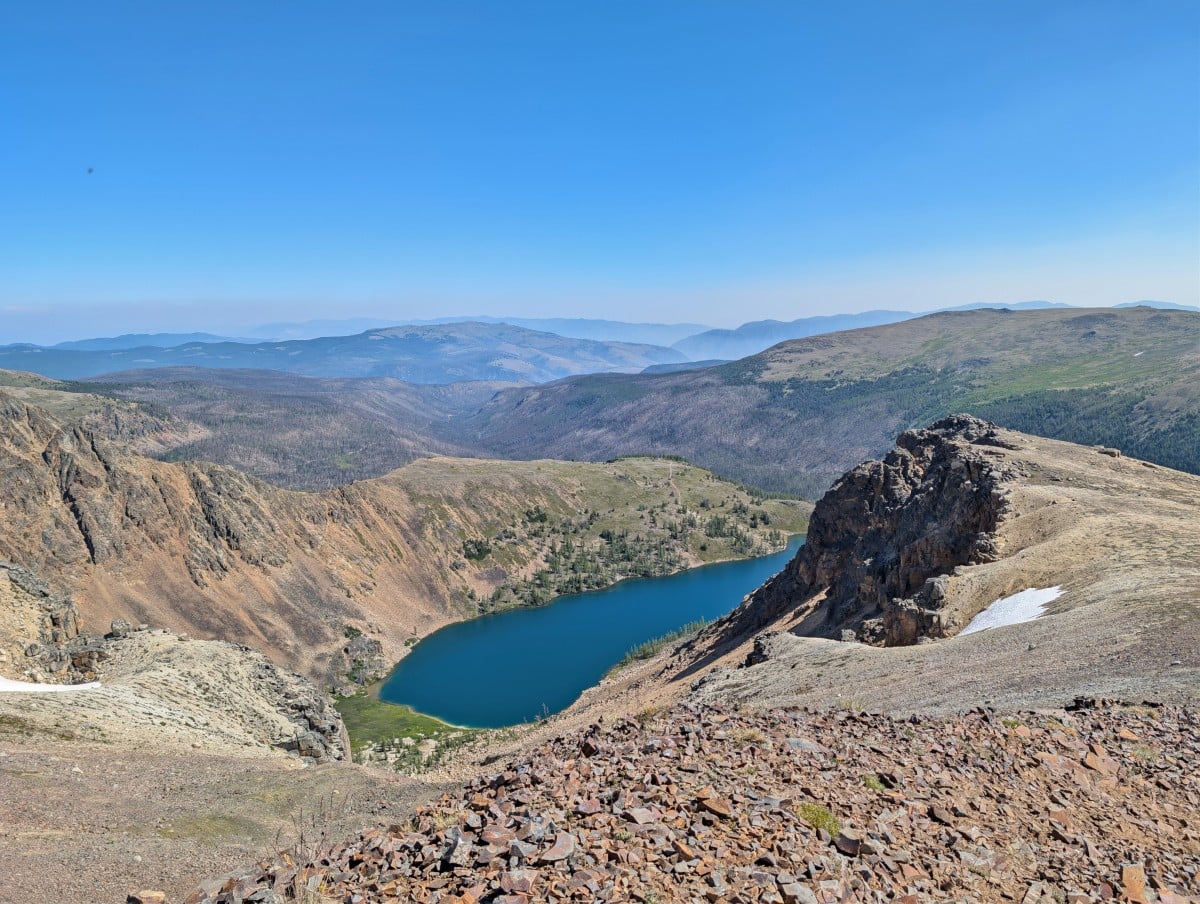
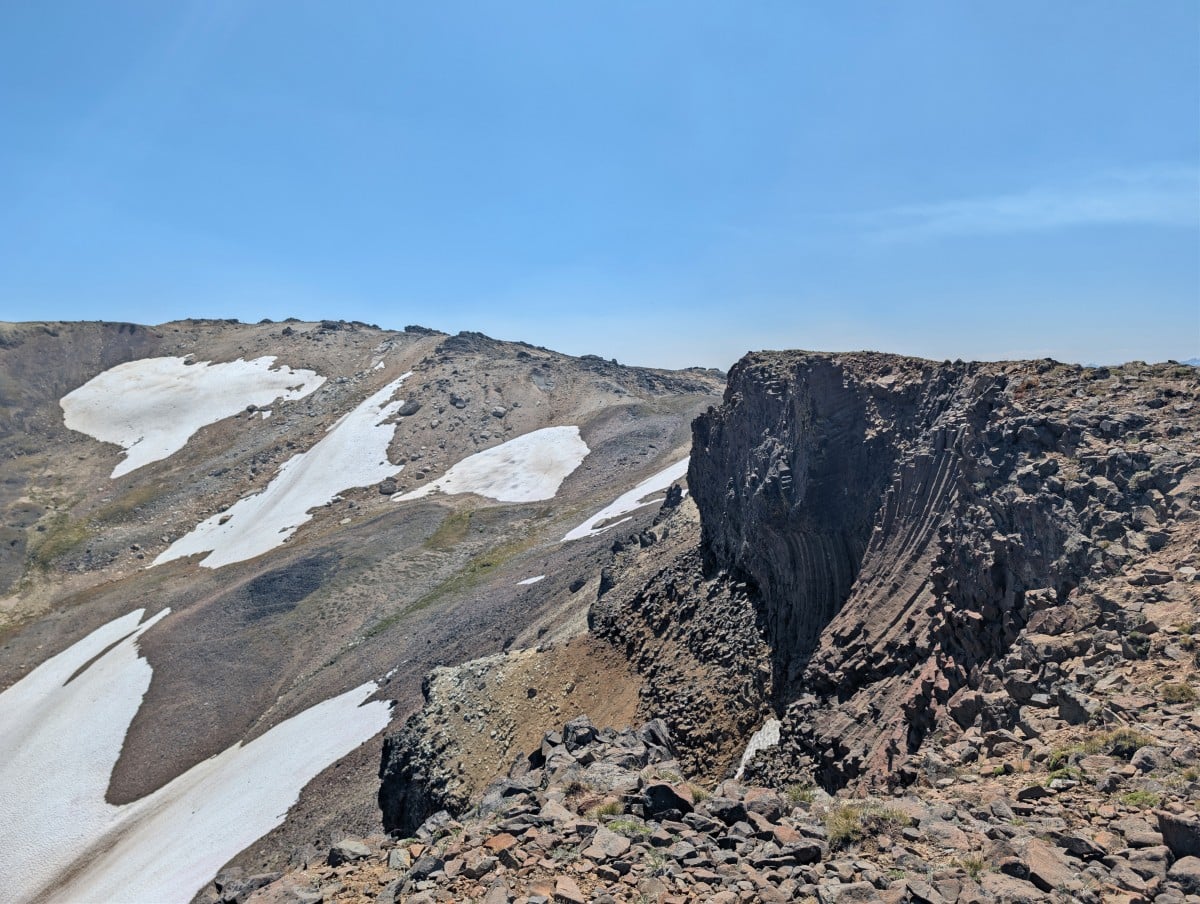
First stop is the Devil’s Woodpile, a basalt rock formation with sloped columns. There are great views of Ladyslipper Lake from here as well.
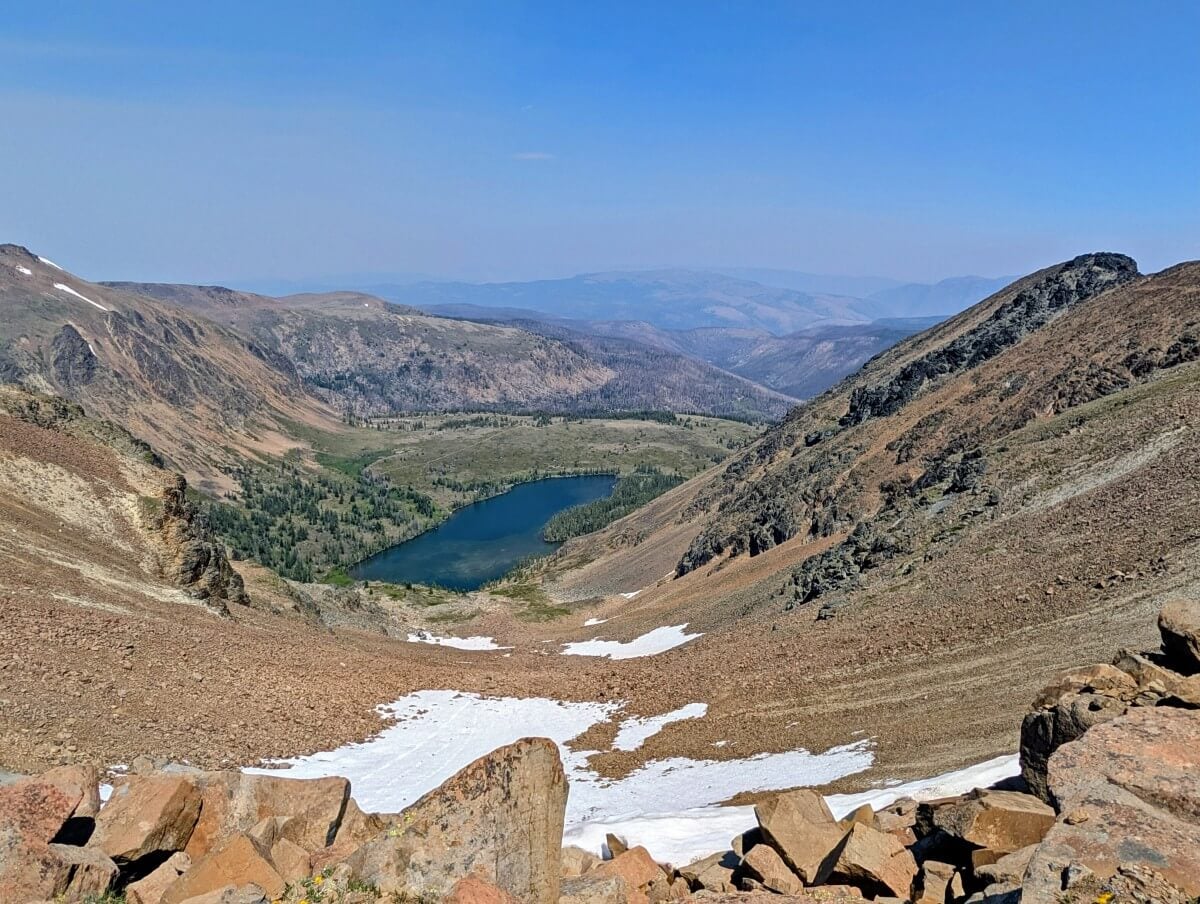
Continuing on, Glacier Lake is visible not long after. At this point, the trail alternates between long stretches of dirt and more rugged, rocky sections. Eventually, there is a junction to exit down to Glacier Lake. There is probably the most popular way to shorten the full Rim circuit.
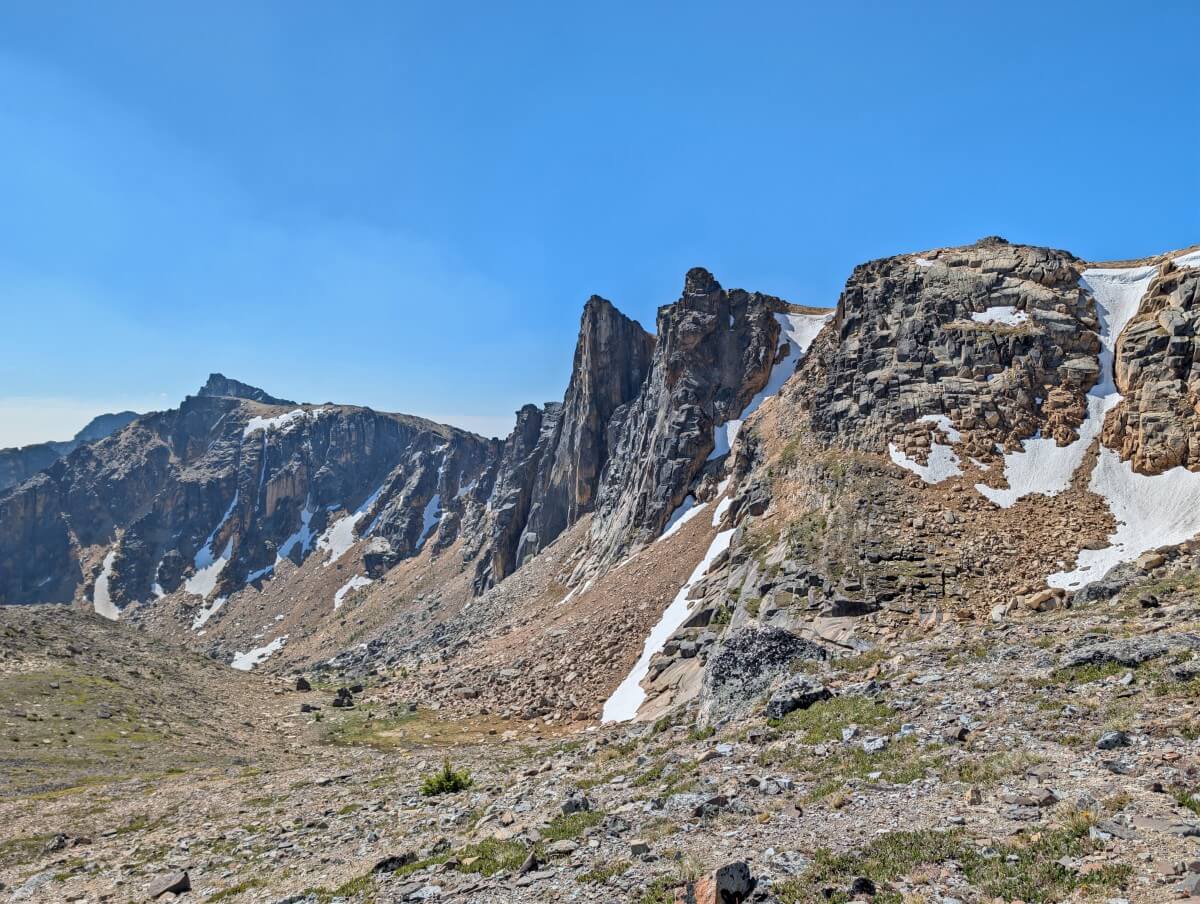
Keep in mind that the descent to Glacier Lake features some loose rock and steep terrain – about 250m elevation loss over 1.4km. In mid July, some snow patches remained.
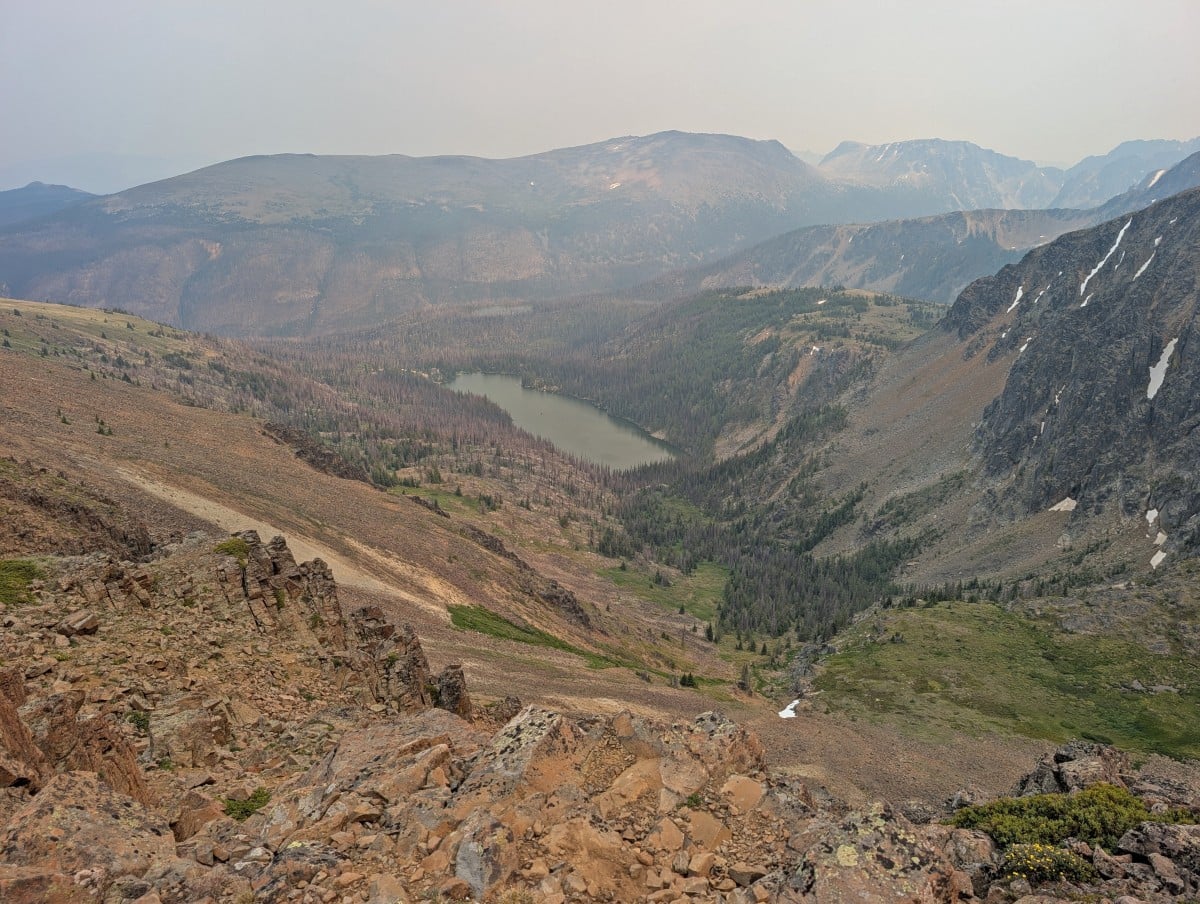
For those that continue, Quiniscoe Mountain lies ahead. The alternating dirt and rocky sections continue, even up the steady climb to the summit cairn (100m elevation gain over 1km). There is a limited view of Quiniscoe Lake from the peak.
Quiniscoe Mountain to Quiniscoe Mountain, via Red Mountain
The Quiniscoe Mountain cairn also marks the start of a short downhill section (150m elevation loss), with again, a mix of rocky and regular trail stretches.
There is another junction – the final opprtunity to leave the Rim Trail early.
The descent down to Quiniscoe Lake is steeper than the one to Glacier Lake, which is probably one of the reasons why it is used less (300m loss in 1.4km). Again, there were some snow patches on the trail in mid July.
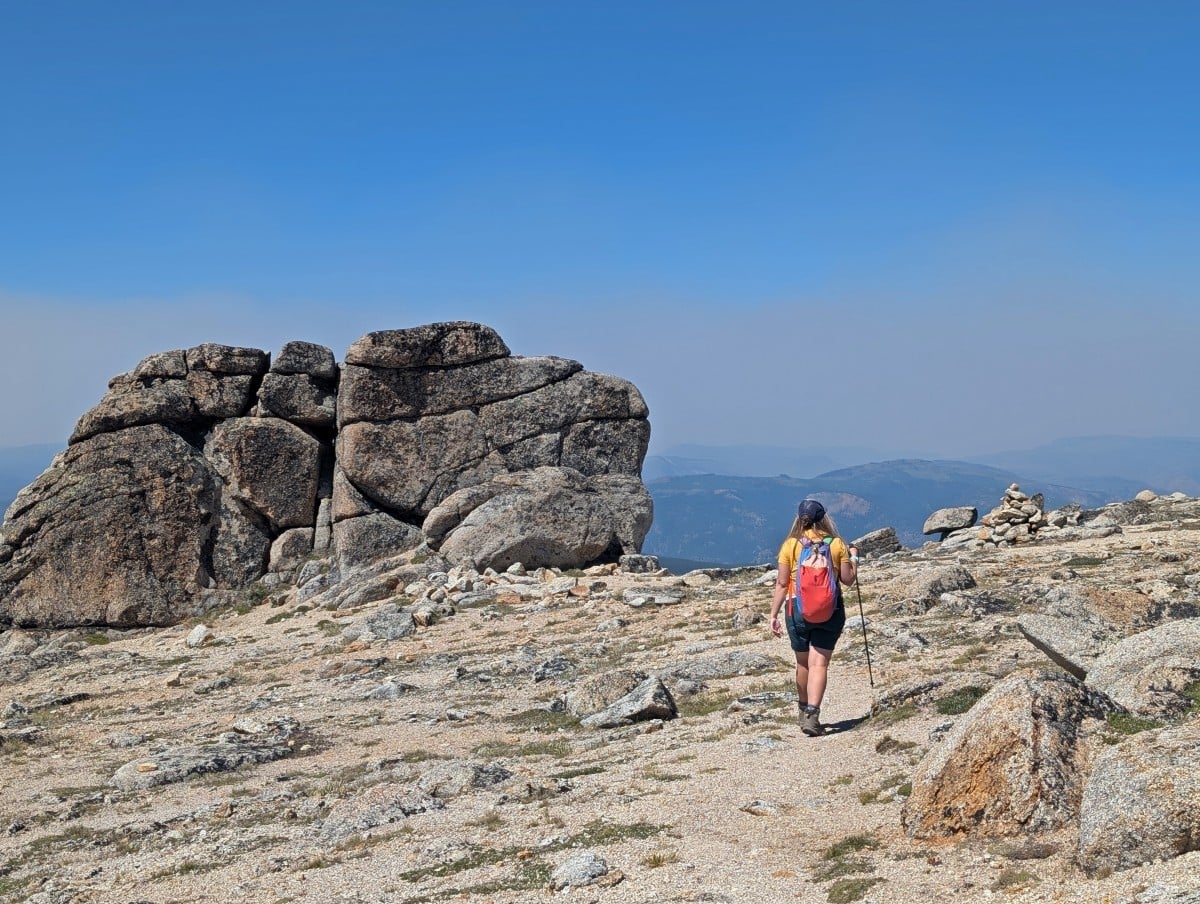
Beyond the Quiniscoe Lake sign, the trail becomes significantly more difficult. A path leads a boulderfield that forms one side of Red Mountain.
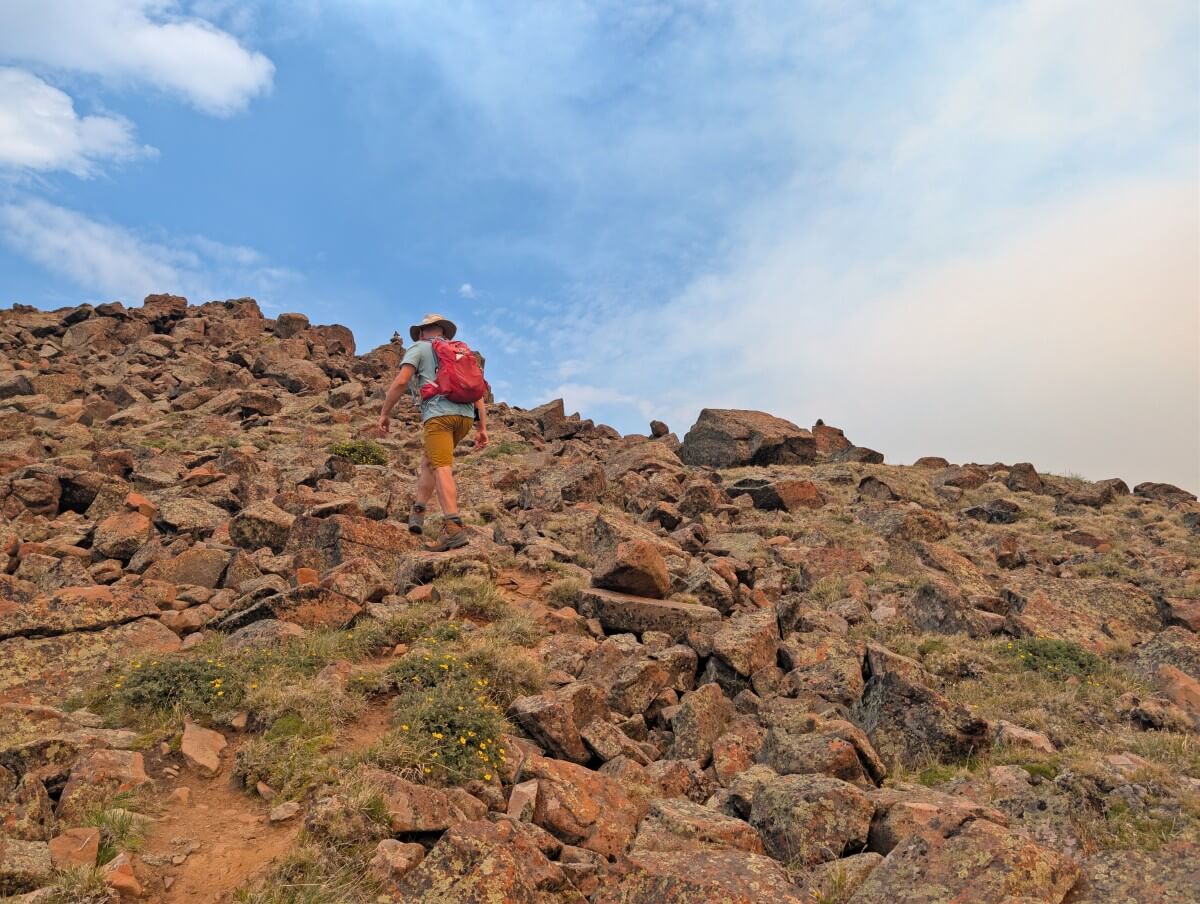
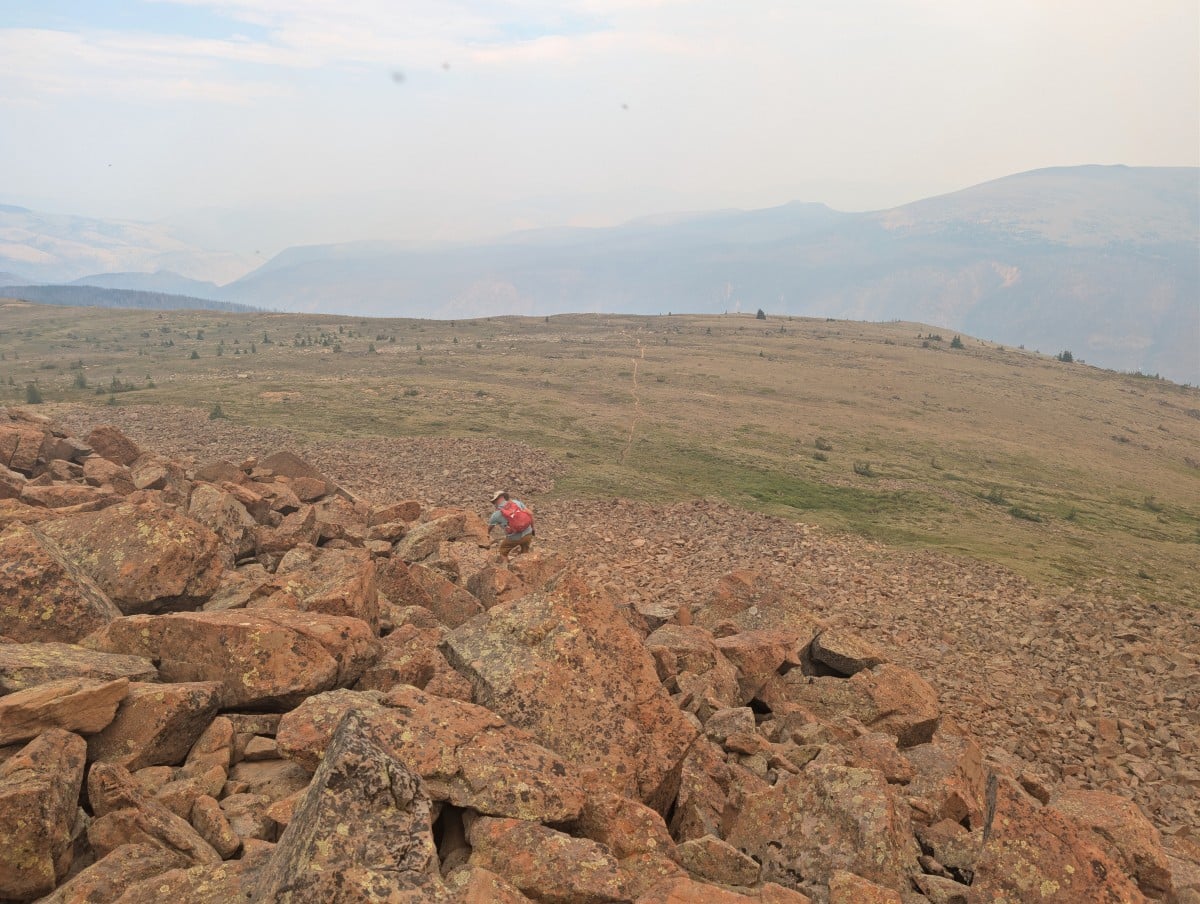
The rocks are small at first and then become very large. The trail can be difficult to follow in places, with cairns marking the route intermittently.
I wouldn’t recommend attempting this section in bad weather, especially if you have limited experience with boulders. While the summit is achieved quickly, there is a larger boulderfield on the other side to traverse. It took us about 45 minutes to traverse 1.3km.
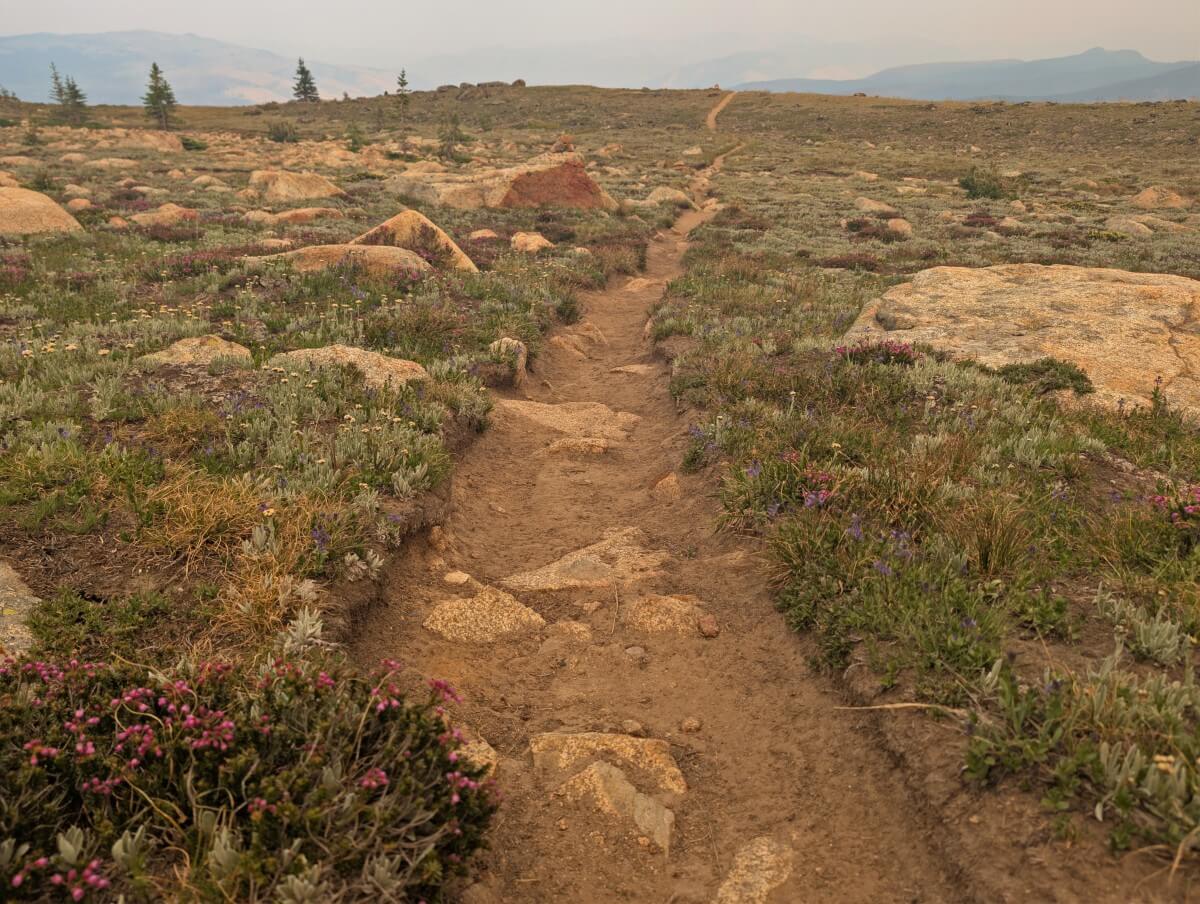
The boulderfield comes to an abrupt end, giving way to a regular trail again. From here, it is an easy hike to the Centennial Trail junction. The views are wide open, with some wildflowers alongside the path in the middle of summer.
The descent begins with a series of switchbacks, which soon bring you back into the burned forest. Watch for another junction to return to Quiniscoe Lake. There are some burned bridges along this stretch and the path is exceptionally dusty. The trail arrives behind the lodge.
When to hike the Rim Trail
The main hiking season in the core area of Cathedral Provincial Park is July to September. The most popular time to hike the Rim Trail is early/mid July to early September, when the trail is snow free and the weather is warmest. Depending on the year, the path may be snow free before that.
On our last visit, in mid July, there were still some snow patches on the steep descents from the Rim Trail to Quiniscoe Lake and Glacier Lake (shorter route options). This was not an issue for us as we hiked the full circuit, which had zero snow.
Cathedral Lakes Lodge runs a shuttle bus to the core area from mid June to mid October. Before this time, many of the trails are still covered (or mostly covered) with snow. The lakes are usually frozen as well.
By the end of September, they may be light snow on the ground. Around late September, the larch trees in the core area turn golden before dropping their needles. The exact timing of the colour peak changes from year to year, depending on the weather and temperature.
Navigating the Rim Trail
The entire Rim Trail Loop route is well used and established, but some sections are easier to follow than others.
The stretch along the tree-less Rim, from Stone City to Quiniscoe Mountain is straightforward, for example. The section between Ladyslipper Lake and Stone City is one of the trickiest, with the first part featuring a rocky ascent with many possible routes.
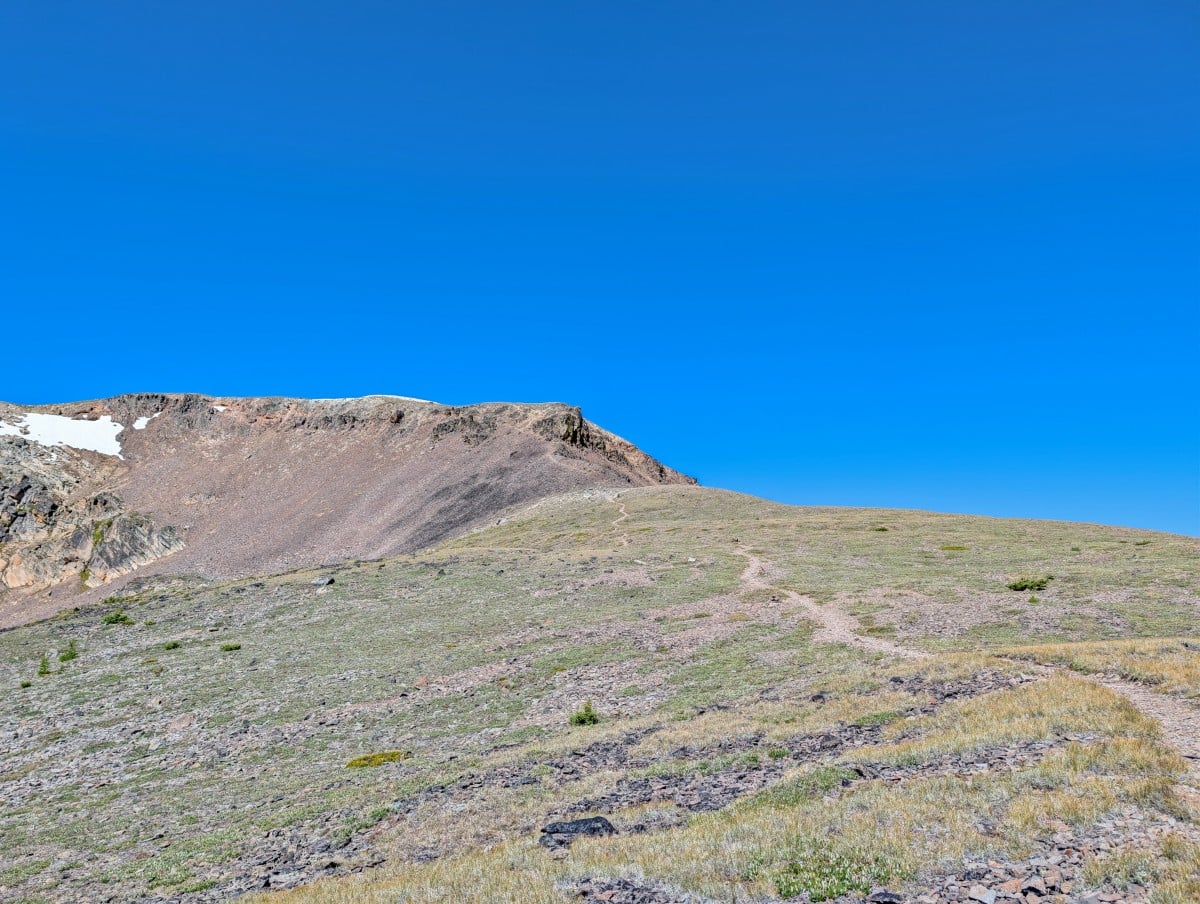
The ‘short-cut’ routes down to Glacier Lake and Quiniscoe Lake are steep, rough in places and are a bit harder to follow.
As mentioned, the Rim Trail Loop is a combination of hiking trails. For this reason, I’d highly recommend getting very familiar with the core area map before heading onto the trail.
There is signage for the individual trails around the campground area and sporadically along the route. Some of the lower elevation signs were burned in the fire and have not been replaced.
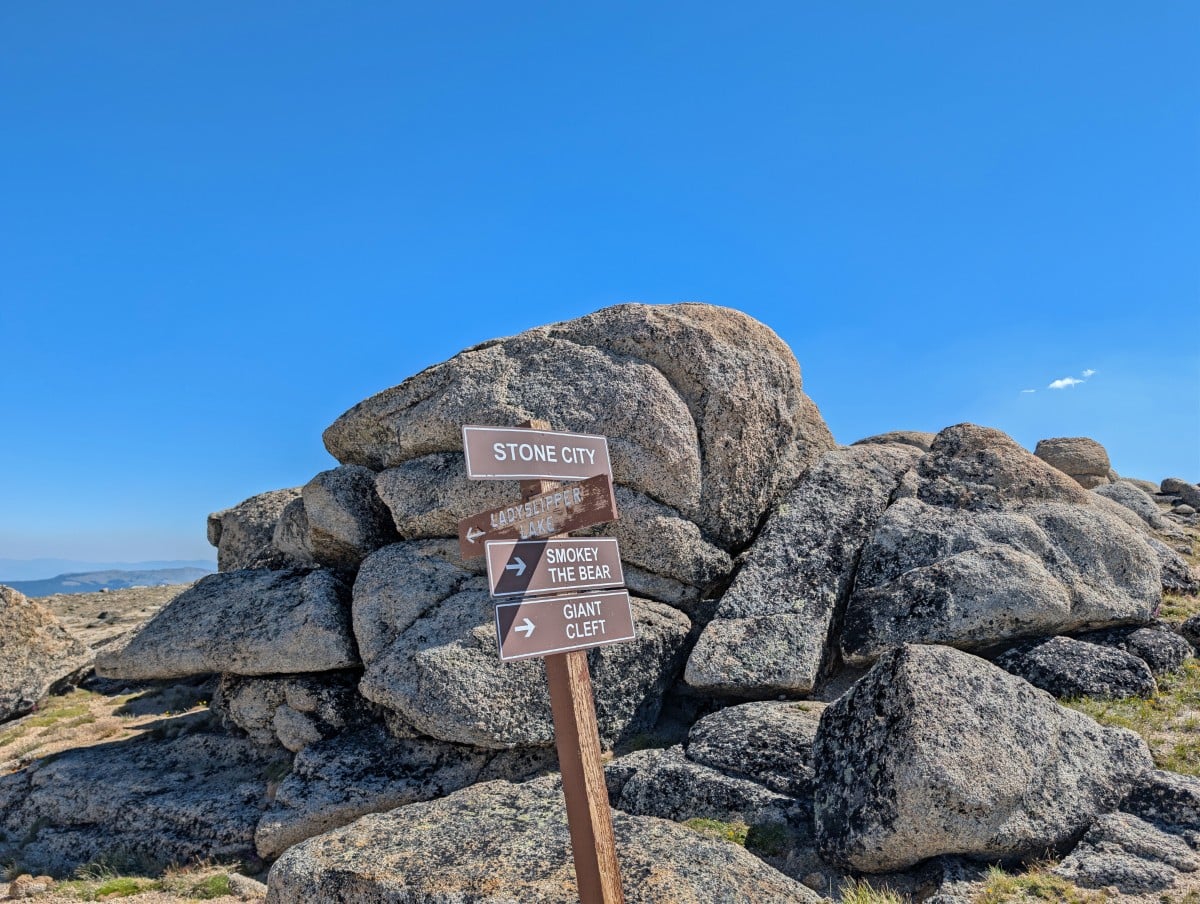
Here’s the order of trails when hiking clockwise from the lodge or Quiniscoe Lake:
- Pyramid Lake Trail
- Ladyslipper Lake Trail
- Cathedral Rim Trail
- Centennial Trail
The above trails are all featured on our favourite hiking app, Organic Maps. Be sure to download the relevant maps before heading to Cathedral and then you can use them offline. The app indicates your position on the trail.
Routing is also available on AllTrails: ‘Cathedral Rim Trail’ (with detour to Smokey the Bear) and shortened ‘Pyramid Lake, Ladyslipper and Cathedral Rim Loop‘ via Glacier Lake.
Hikers have gone missing (and been found) in Cathedral over the years, such as this couple in 2022. Back in 2015, two hikers went missing in the park for a week. Hiking in a heavily forested area, they encountered some unexpected weather and subsequently lost the trail.
Trail difficulty
The full Rim Trail is a challenging hike, mainly due to the length, elevation gain and some of the terrain. The shortened routes are a bit easier due to the reduced distance and total elevation gain.
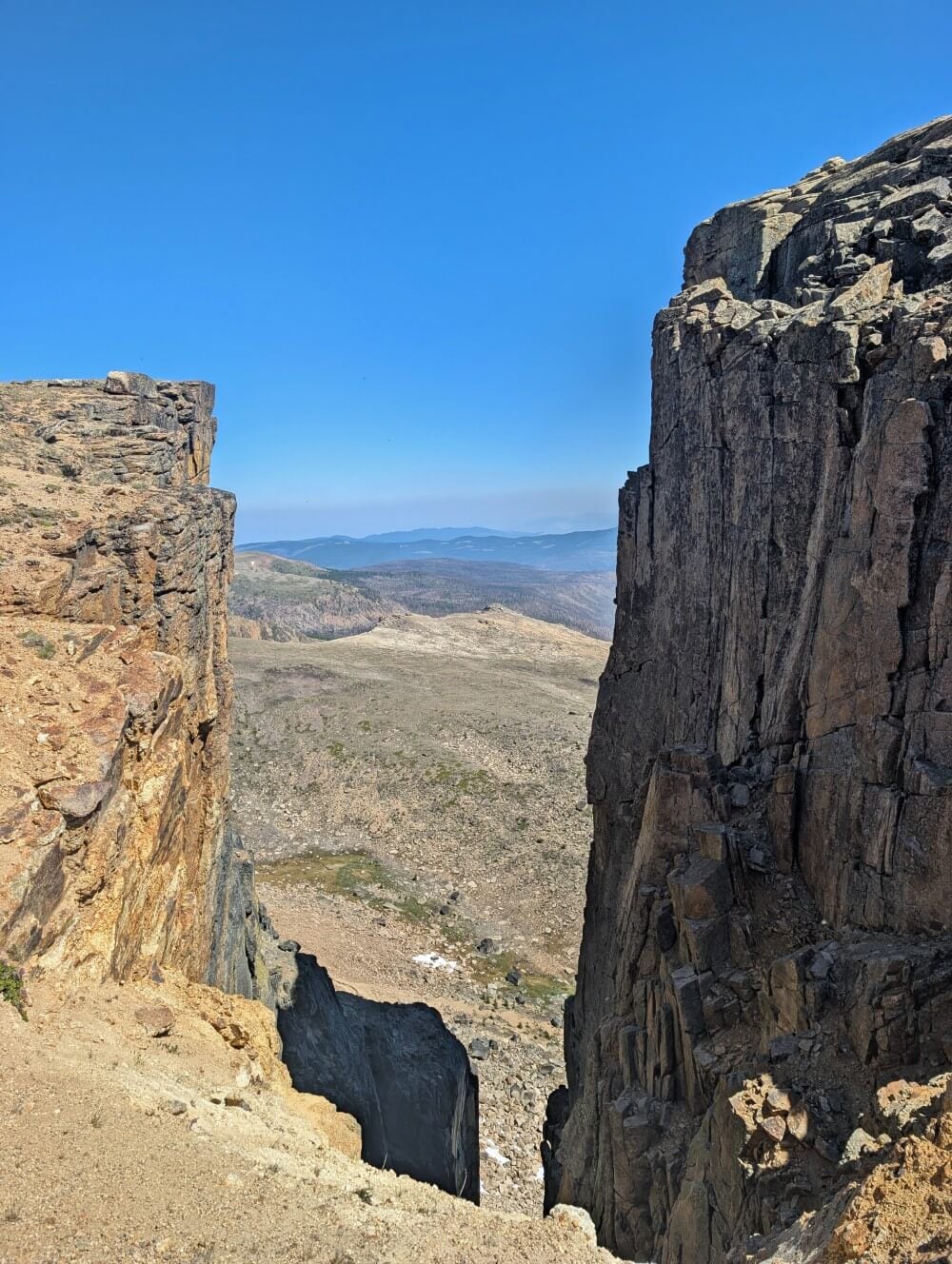
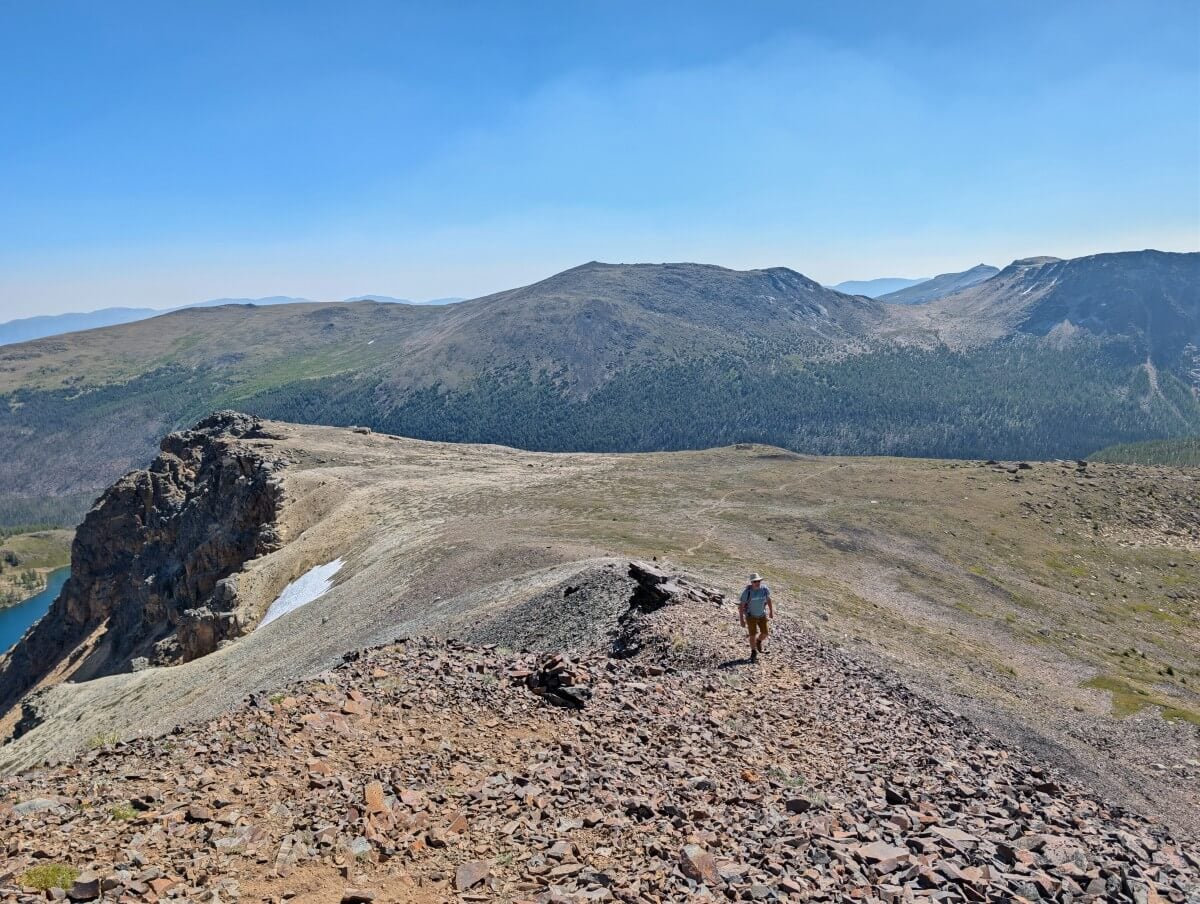
The ‘short-cut’ descent routes require attention, however, since they involve steep terrain and loose rock (see above photo).
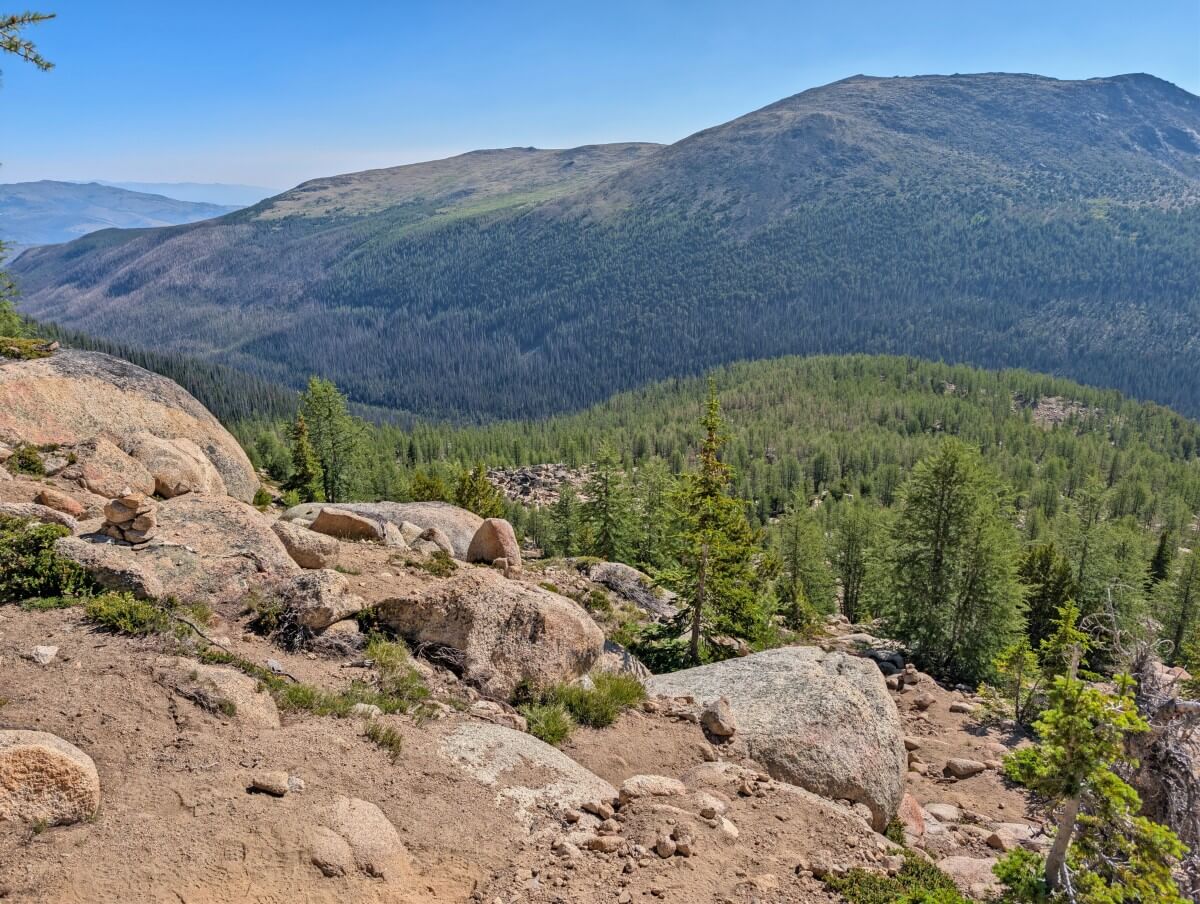
If travelling clockwise, the first climb on the full circuit occurs between Pyramid Lake and Ladyslipper Lake, where a series of switchbacks climbs steadily uphill.
The next ascent is after Ladyslipper Lake, which features a steep climb up a rocky slope. There are many different possible routes here. Eventually, the route mellows out to a regular trail through open alpine terrain.
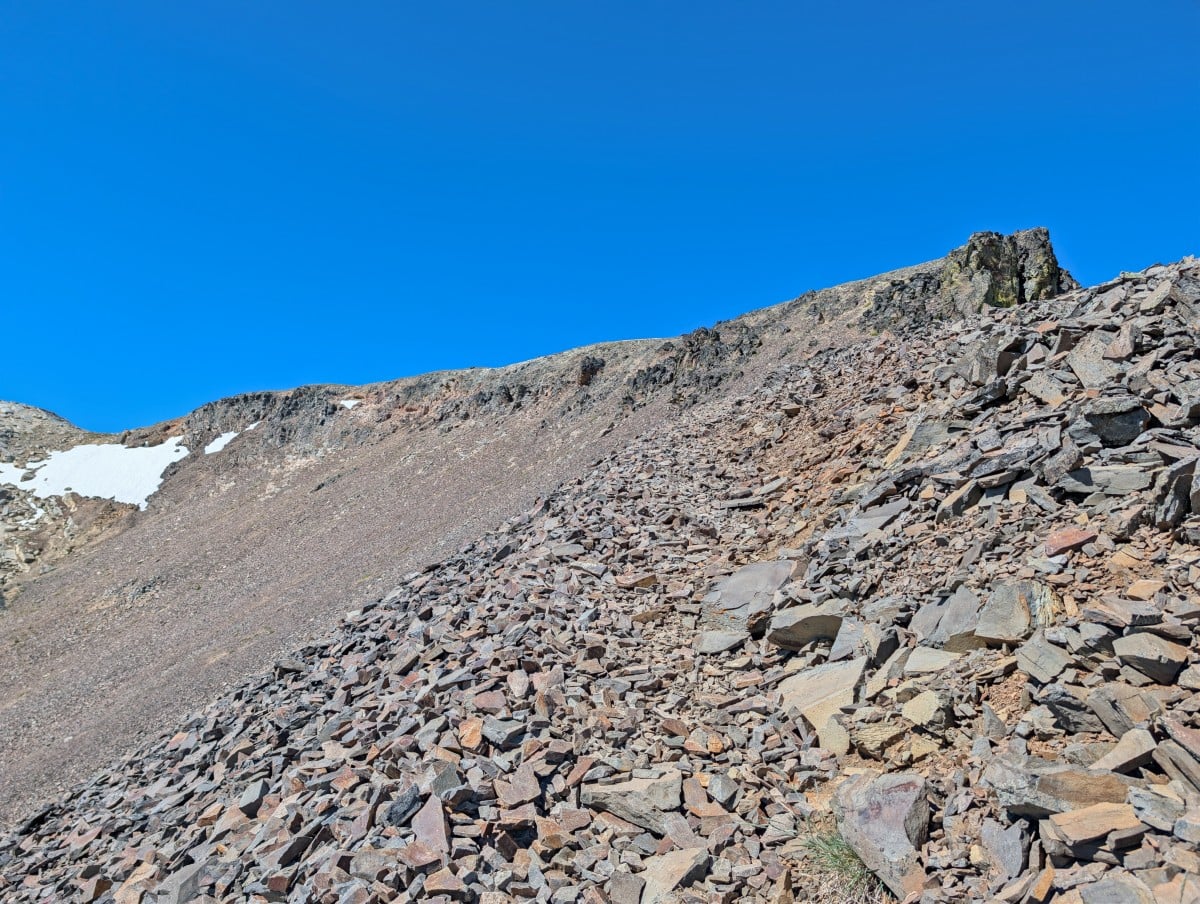
The final climb up to the Rim (via Ladyslipper) involves a short but steep climb up a scree/slate rockfield. There is a drop on both sides.
The other significant ascents are Quiniscoe Mountain and Red Mountain. The latter is not a trail, but rather a large boulderfield. This can take a significant amount of time to traverse, depending on your bouldering skills.
Permits, fees and camping reservations
There are no fee or permit required to hike the Rim Trail or visit Cathedral Provincial Park.
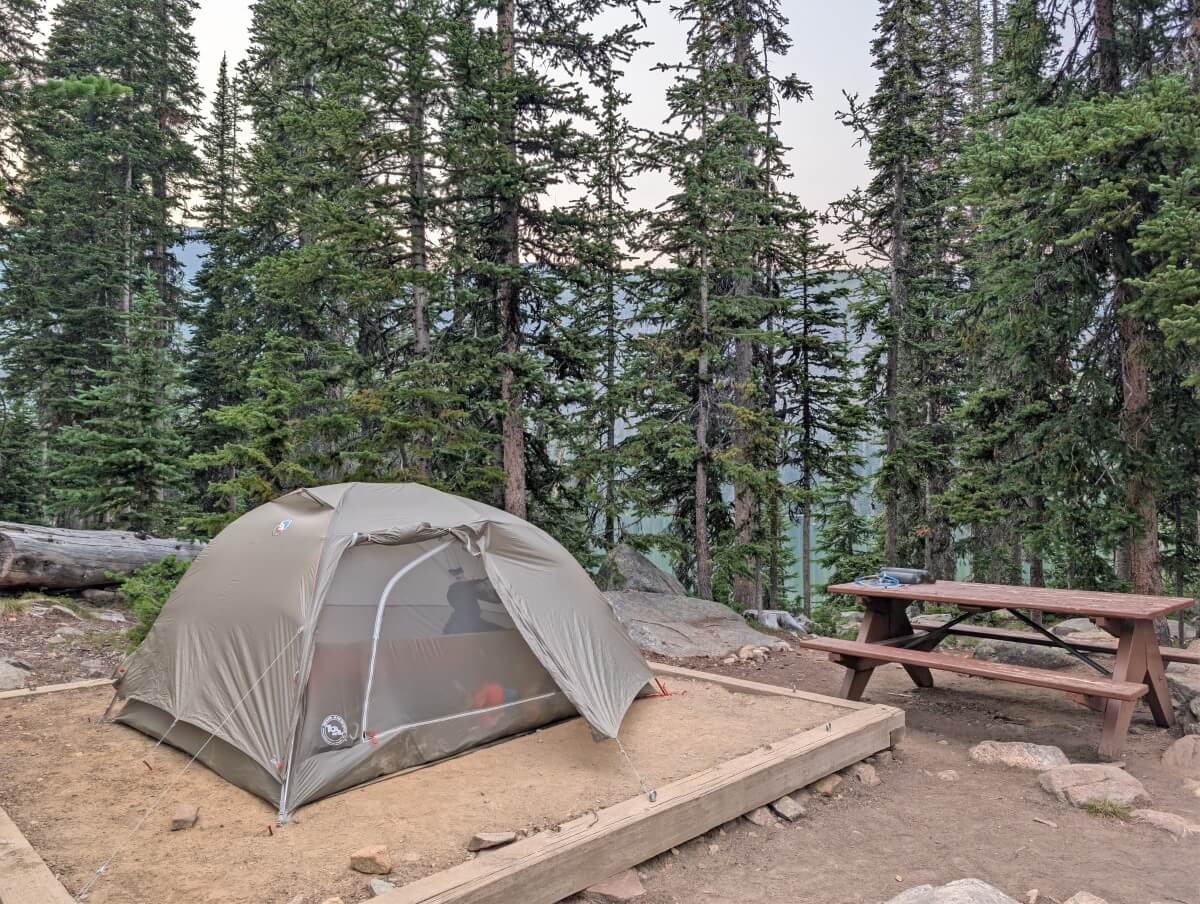
As mentioned, Cathedral Lakes Lodge charges a fee for a ride on the shuttle. For camping, the cost is $10/adult/night, with an additional $20/stay fee for non-BC residents. No ‘wild’ camping (outside of Quiniscoe Lake Campground) is allowed in the core area.
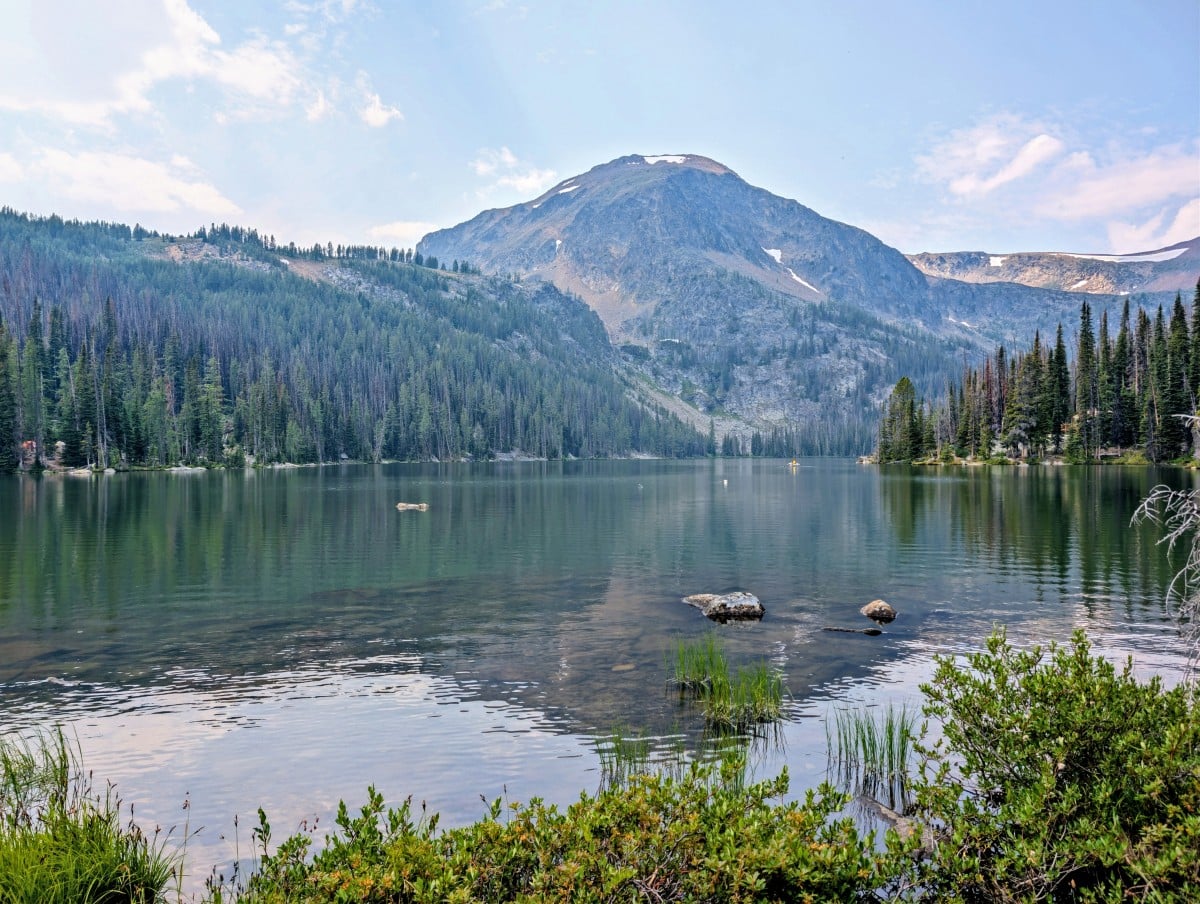
There are 30 backcountry sites at Quiniscoe Lake, with reservations being required from late June to mid September. Reservations can be made up to three months before your planned arrival date via the BC Parks website.
Outside the main hiking season, registration is still required. You can register online up to two weeks before arrival through the BC Parks website or in person at the campground entrance kiosk, where payment envelopes are available. Bring cash if registering in person.
More information about the Quiniscoe Lake Campground in our dedicated Cathedral Lakes guide.
Safety and other essential information
The core area of Cathedral Provincial Park is busy with visitors in summer, but it still located in a remote backcountry area.
Here are some of the main hazards to be aware of:
- Weather. Conditions can change quickly in high elevation areas such as this. Snow is possible even in the middle of summer. The weather on the rim may be different than in the campground.
- Elevation gain. The access routes to the Rim are steep in places. If you do not hike regularly, you may still find it very tiring. This is especially true if it’s hot. Pace yourself
- Shade and water sources are limited. Wear a hat, bring sunscreen and carry plenty of water (2l or more). There are no creeks on the Rim itself – we only found a tarn near Quiniscoe Mountain
- Communication. There is no phone signal in Cathedral Provincial Park. Tell someone where you’re going and when you plan to be back. We bring a satellite Inreach for emergencies. If you need urgent help at the campground, head to the lodge or find the PFO (park facility operator)
- Navigation. As mentioned above, most of the trails in Cathedral are reasonably well defined but would be easy to get distracted and miss a turning. Pay attention to your surroundings
- Though popular, hiking the Rim Trail can feel very quiet at times. As mentioned, we only saw a handful of hikers each time. Bring everything you need to be safe on the trail
- Wildlife. Please read the information below about how to stay safe around Cathedral’s mountain goats.
Wildlife
Cathedral Provincial Park is home a wide range of animals including bighorn sheep, mule deer, badger and marmot. Sightings of black bear and grizzly bear are very rare but not impossible.
The most well known residents of Cathedral are the mountain goats. The park is home to around 30 goats which are often sighted by hikers and campers. We saw them near Quiniscoe Mountain and also in the campground in the morning.
Unfortunately, Cathedral’s mountain goats are in danger of being too habituated (used to humans). Mountain goats can be very large and use their horns to defend their personal space.
The chance of encountering an aggressive mountain goat in Cathedral is very unlikely. When they do approach humans, they are usually looking for sources of salt – urine and sweaty clothing.
To prevent the goats becoming more habituated, you can help by:
- Maintaining a safe distance from mountain goats (at least 50m)
- Not urinating on the ground in the campgrounds
- Not urinating on or near trails, move at least 50m off the trail
- Disposing of grey water (waste water from washing dishes) in outhouses
- Not leaving sweaty clothing and equipment outside of your tent
If a mountain goat does approach you, move away to a safe distance. If it continues to approach, chase it off by yelling and throwing rocks. Report the incident to the campground’s PFO (park facility operator) as soon as possible.
Recommended items to bring
As well as your 10 Essentials, I’d recommend bringing the following items on your Rim Trail hike:
- Warm layers. No matter what the forecast says, bring a mix of clothing on your Cathedral adventure. It was easily 25 degrees on the August day we hiked the Rim Trail but the morning before, we had hiked in light snow
- Sun and snow protection. On the same theme as above, bring a warm toque (and a pair of gloves!) as well as a sun hat and sunscreen. Weather conditions can change quickly. It can also be windy on the rim.
- Portable charger. Be sure to bring a power bank for your phone. There are no facilities to charge items in Cathedral Provincial Park unless you stay at Cathedral Lakes Lodge
- Hiking poles. The ascents and descents on the Rim Trail can be quite steep. I would highly recommend bringing hiking poles. My favourite poles (and the ones I used on the Rim Trail both times) are the Black Diamond Distance Z. They are super light and also are easy to fold down when not in use
- Extra cash. Cathedral Lakes Lodge sells chips, cookies, beer, wine and soda – a great reward after your Rim Trail hike!
Other posts you may find helpful
Okanagan Mountain Park: A Complete Hiking and Paddling Guide
Vancouver to the Okanagan Valley Road Trip Guide: Best Places to Stop
17 of the Best South Okanagan Hiking Trails
Okanagan Valley Road Trip: What to Do and Where to Stop
The Best Okanagan Valley Waterfalls, British Columbia
Frosty Mountain Larches, Manning Park: Everything You Need to Know
Check out these recently published posts:

One half of the Canadian/British couple behind Off Track Travel, Gemma is happiest when hiking on the trail or planning the next big travel adventure. JR and Gemma are currently based in the beautiful Okanagan Valley, British Columbia, Canada. Consider buying us a coffee if you have find any of our guides helpful!
Fantastic, Amazing, Wonderful. What a hike!!
Hello!
Just a question about this hike. Could this be done in a day? And I have never heard of the shuttle before that takes you into the core area. Could you provide some more information about this?
Thanks!
Hi there! The Rim Trail itself is a day hike. The shuttle is run by Cathedral Lakes Lodge – http://cathedrallakes.ca/ Looking at their website, they have a shuttle for day trippers going up at 8am and down again at 5pm. If you are reasonably fit, that should be enough time to do the Rim Trail.
Hi! I just have a question, a couple of friends and I were planning on doing this hike in the afternoon starting at about 1 pm, would this give us enough time?
Hi Laura, this is super dependent on your hiking speed and ability. If you’re doing it soon, you would have plenty of light! If starting at 1, we would have finished at 7ish, which is doable.
Fabulous blog. Loved the one about no hassle cathedral park too. Hoping to go this summer. How many days do u recommend? We were thinking fri to monday..
That sounds perfect! I would have said three days minimum but four is ideal if you love to hike and want a bit of downtime too.
I’m glad you liked the Cathedral Park posts!
Hi I’ve been wanting to do this trail for years. What time of year did go. We are hoping end of June this year. Also did you hike in or is it best to take the shuttle?
The Rim Trail really is awesome – I’m pretty sure it will live up to your expectations! We hiked this trail in August. Depending on the winter snow depths and spring weather, late June may be a touch too early.
I think you’d find this post helpful, it describes the rest of our experience in Cathedral Provincial Park https://offtracktravel.ca/backcountry-life-cathedral-provincial-park-bc-canada/ (we took the shuttle)
Hi I live in Summerland about 1.5 hrs from the park. Do you think this could be done as a day trip (with shuttle in) or is it best done camping for a few nights? Hoping to go in early July. We are having a very warm spring so hope that is doable with regards to snow.
Hi Karen,
For most hikers, it would be possible to do in a day trip as the shuttle runs at 8am and returns to the base at 5pm. So as long as you’re a reasonable hiker (not extraordinarily slow), you could do it. For the full enjoyment of the hike (and also to get good value from the bus ride up) I would camp for a couple of nights. Cathedral Provincial Park really is a beautiful area.
How do I book a camping spot
Hi Colleen,
It is not possible to reserve a camping spot in Cathedral Provincial Park in advance – the campgrounds work on first come, first serve only.